
Emotional regulation isn’t something we’re born knowing how to do — and it’s not something we master once and move on from.
It’s a lifelong skill that grows through understanding, connection, and practice.
This series explores what emotional regulation really is, how it develops, why it breaks down under stress, and how we can strengthen it at any age.
Why Does This Keep Happening?
If you’ve ever thought, “I know what to do — so why can’t I do it right now?” you’re not alone.
Under stress, many people notice that their best coping skills seem to disappear. They react more quickly than they want to, feel overwhelmed by small things, or fall back into old patterns they thought they’d outgrown. This can be confusing and discouraging, especially for people who have done a lot of self-work.
It’s tempting to interpret this as failure or regression — but what’s actually happening is much simpler and much more human.
Stress doesn’t erase growth.
It temporarily changes how the nervous system operates.
When pressure increases, your system isn’t asking, “What’s the most thoughtful response?”
It’s asking, “Am I safe right now?”
Understanding this shifts the experience from self-blame to self-awareness — and that shift alone is regulating.
Stress Is a Nervous System State, Not a Personality Trait

Stress is not a flaw, a weakness, or a sign that you’re “bad at coping.”
It’s a state of the nervous system.
When stress rises, the body moves into protection mode automatically. This can happen in response to emotional strain, uncertainty, conflict, overload, or even prolonged busyness. The response is fast, instinctive, and not conscious.
This is why stress can show up as:
- Snapping at people you care about
- Freezing when decisions need to be made
- Avoiding conversations you normally handle well
- Overthinking simple choices
- Feeling emotionally flat or shut down
These responses aren’t chosen — they’re protective. life.
Common Stress Myths
Myth: “If I were emotionally regulated, this wouldn’t affect me.”
Reality: Regulation doesn’t prevent stress responses — it supports recovery.
Myth: “I should be able to handle this by now.”
Reality: Stress capacity changes depending on context, load, and support.
Myth: “Other people seem fine — why am I not?”
Reality: You’re seeing behaviour, not nervous system state.
Stress doesn’t say anything about who you are.
It tells you what your system is responding to.

What Happens in the Brain Under Stress
When stress increases, the brain and nervous system shift priorities.
Energy moves away from areas responsible for reflection, planning, and emotional nuance, and toward areas focused on survival. This isn’t a malfunction — it’s an ancient design meant to keep humans alive.
You might notice:
- Thinking becomes more rigid or black-and-white
- Emotions feel bigger and harder to manage
- Logic feels out of reach
- Reactions happen faster than awareness
A helpful way to think about this is that the brain goes into emergency mode. When that happens, there’s less capacity for:
- Perspective-taking
- Patience
- Creative problem-solving
This is why “just calm down” doesn’t work — and why trying to reason with yourself mid-stress often feels impossible.
Real-Life Examples
- A parent who is usually patient suddenly feels overwhelmed by a small request at the end of a long day.
- A teen who understands their emotions still shuts down during conflict.
- An adult who communicates well at work freezes when emotions are involved at home.
In each case, the nervous system isn’t failing — it’s prioritizing safety.
And the most important thing to remember is this:
You can’t think your way out of a state your body is in.
Regulation returns not through effort or control, but through restoring a sense of safety — something we’ll explore more deeply as this series continues.

What Support Can Look Like When the System Is Overwhelmed
When emotional regulation breaks down, the instinct is often to try harder — to fix, control, or push through. But regulation doesn’t return through effort alone. It returns through safety.
This is where it helps to shift away from asking “What should I do right now?” and toward “What does my system need to feel steadier?”
For many people, the most helpful starting point isn’t another technique — it’s awareness. Understanding how stress shows up for you, how your body responds, and what patterns emerge under pressure creates the foundation for change.
When old patterns tend to resurface under pressure or when stress rises, the nervous system reaches for what’s familiar, not what’s ideal.
In Part 4: Practical Tools for Building Regulation at Any Age, we’ll explore how regulation can be strengthened over time — gently, intentionally, and in ways that meet you where you are.
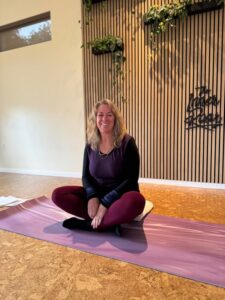
A Personal Note: When Stress Had No Other Way Out
Looking back now, I can see that there was a long period of my life when my nervous system was under constant stress — and I didn’t yet have the language or tools to understand what was happening.
Emotional regulation wasn’t just difficult — it was something I didn’t know existed.
My emotional vocabulary was very small. Like Brené Brown describes in Atlas of the Heart, I only had access to a few labels: mad, sad, or happy. When emotions showed up that didn’t fit neatly into those categories, my system had nowhere to put them. They came out sideways — as anger or as collapse.
Anger looked like rage over small things.
Sadness looked like days in bed, “sick,” withdrawn, and heavy.
My family even had a nickname for the rage — the witchy bitchy woman. She was scary. Honestly, she was scary even to me.
At the time, I didn’t know I was dysregulated. I didn’t know my nervous system was overloaded. I didn’t even know I could feel emotions in my body. The only sensations I recognized were attached to anger — tightness, heat, tension. Everything else felt numb or invisible.
Stress kept building with no release.
Eventually, my body forced a pause. I developed shingles in my ear — Ramsay Hunt syndrome — which paralyzed half my face. What followed was deep exhaustion and depression, which I initially blamed on the medication I was taking. Looking back now, I can see how profoundly overwhelmed my system had become.
By chance — and timing — I went to see an acupuncturist who suggested yoga.
That suggestion changed everything.
Yoga helped me feel my body for the first time — not as something working against me, but as something I could listen to. I began to notice sensations without needing to label or explain them. From there, I slowly started to recognize that different emotions lived in different places.
Over time, patterns became clear:
- Hyper-tension in my body
- Grinding and gritting my teeth
- “Sleeping stress” that never felt restful
- Pain in my hands and feet
All of it was communication. My body had been expressing what my mind didn’t yet have language for.
As I learned more about how the mind works — especially the harsh, critical things I used to say to myself — I stopped treating my body like the enemy. I began to befriend it. Slowly, my mind, body, and spirit started working together instead of fighting each other.
Ten years later, my emotional world is much richer. There’s nuance now. There’s choice. There’s awareness. Not perfection — I’m human — but far more calm and steadiness than before.
And that’s the part I want to emphasize:
Emotional regulation didn’t arrive all at once.
It came through practice, curiosity, and learning to listen — especially when stress was loud.
If stress brings old patterns back online for you, it doesn’t mean you’re failing. Sometimes it means your system learned one way to cope — and is now ready to learn another.
Understanding stress through the body changed everything for me — and it’s why I believe so deeply that awareness is where regulation begins.
I share this not because everyone’s story looks like mine, but because stress often shows up long before we recognize it as stress. When emotional regulation breaks down, it’s often the nervous system asking for a different kind of support.
Explore the Emotional Regulation Series:
- Part 1: What Emotional Regulation Is
- Part 2: Before Self-Regulation Comes Co-Regulation
- Part 3: Why Regulation Breaks Down Under Stress
- Part 4: Strengthening Regulation at Any Age
Building Emotional Regulation Is a Skill
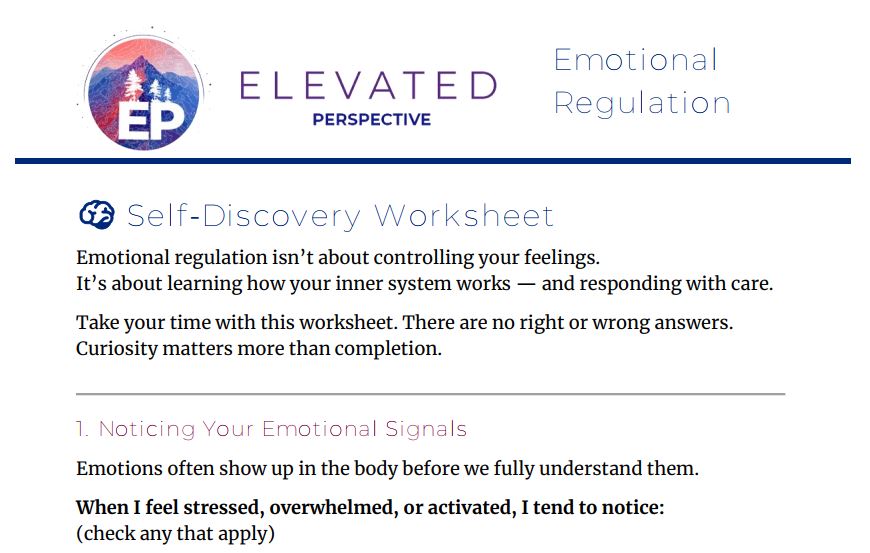
This worksheet is a gentle place to explore how emotional regulation shows up for you. There’s nothing to solve — just space to notice, reflect, and build awareness over time.
Emotional regulation can be strengthened at any age.
Some simple entry points include:
- Learning how your nervous system signals safety and stress
- Understanding the difference between the thinking brain and the feeling brain
- Using breath, movement, and awareness to settle the body
- Practicing curiosity instead of judgment when emotions arise
- Building moments of pause into daily life
Small, consistent practices matter more than big breakthroughs.