
Emotional regulation isn’t something we’re born knowing how to do — and it’s not something we master once and move on from.
It’s a lifelong skill that grows through understanding, connection, and practice.
This series explores what emotional regulation really is, how it develops, why it breaks down under stress, and how we can strengthen it at any age.
The Practice of Growing Emotional Regulation
By now, you’ve seen that emotional regulation doesn’t break down because something is wrong — it breaks down because stress changes how the nervous system functions.
Old patterns resurface.
Tools stop working when capacity is low.
Stress builds quietly until the system reaches its limit.
If this is your first post in the series, you may want to begin with Part 1: Emotional Regulation — What It Is, Why It Matters, and How It Evolves, where I lay the foundation for understanding regulation across the lifespan.
This context matters, because how we understand these experiences shapes how we respond to them.
Emotional Regulation Over Time

Why Old Patterns Still Show Up
Under pressure, the nervous system reaches for what’s familiar, not what’s ideal.
Old patterns — people-pleasing, shutting down, anger, avoidance, control — were once adaptive responses. They helped you cope at a time when your system needed protection. When stress rises, those pathways are simply easier to access.
This doesn’t mean you’re back at the beginning.
It means your system is responding with what it knows.
The goal of regulation work isn’t to eliminate these patterns, but to recognize them sooner and respond with more choice.

Why Tools Don’t Work When You’re Already Overwhelmed
Many people blame themselves when coping tools fail under stress. In reality, this is a timing issue, not a skill issue.
Tools require:
- Attention
- Choice
- Flexibility
High stress reduces all three.
This is why emotional regulation isn’t built in the middle of overwhelm. It’s built around it — during calmer moments, recovery phases, and everyday life. Over time, those practices increase capacity, so stress has less impact when it does arise.
Regulation is not about controlling peak moments.
It’s about recovering more gently and more quickly.

Why Cumulative Stress Changes Everything
Stress rarely comes from one dramatic event. It builds through layers:
- Interrupted sleep
- Emotional labour
- Constant decision-making
- Uncertainty
- Transitions
- Holding things together for others
The nervous system experiences this as total load.
This is why people often say, “Nothing big happened — I just couldn’t cope.”
Something did happen. Capacity was exceeded.
Understanding cumulative stress helps us stop minimizing our experience and start respecting our limits

Building Emotional Regulation Over Time
Emotional regulation isn’t a single tool or technique — it’s a skillset that develops gradually through awareness, repetition, and safety.
The most effective tools work with the body, not against it.
1. Build Awareness Before Action
Regulation begins with noticing:
- Early stress signals
- Emotional patterns
- Body sensations
Awareness creates choice — even when emotions are strong.
This is why reflection tools, journaling, and gentle check-ins matter. They help you recognize what’s happening before the system is overwhelmed.
2. Use Body-First Regulation
When stress rises, the body leads.
Helpful supports include:
- Slowing the breath
- Feeling contact with the ground or a chair
- Gentle movement or stretching
- Reducing sensory input
- Restoring rhythm through routine
These approaches create safety first — which allows thinking and emotion to follow.
3. Normalize Co-Regulation at Every Age
Humans regulate better with support.
For children, this might be physical closeness.
For teens, it might be calm presence without pressure.
For adults, it might be conversation, shared space, or feeling understood.
Needing connection doesn’t mean you’re dependent.
It means your nervous system is human.
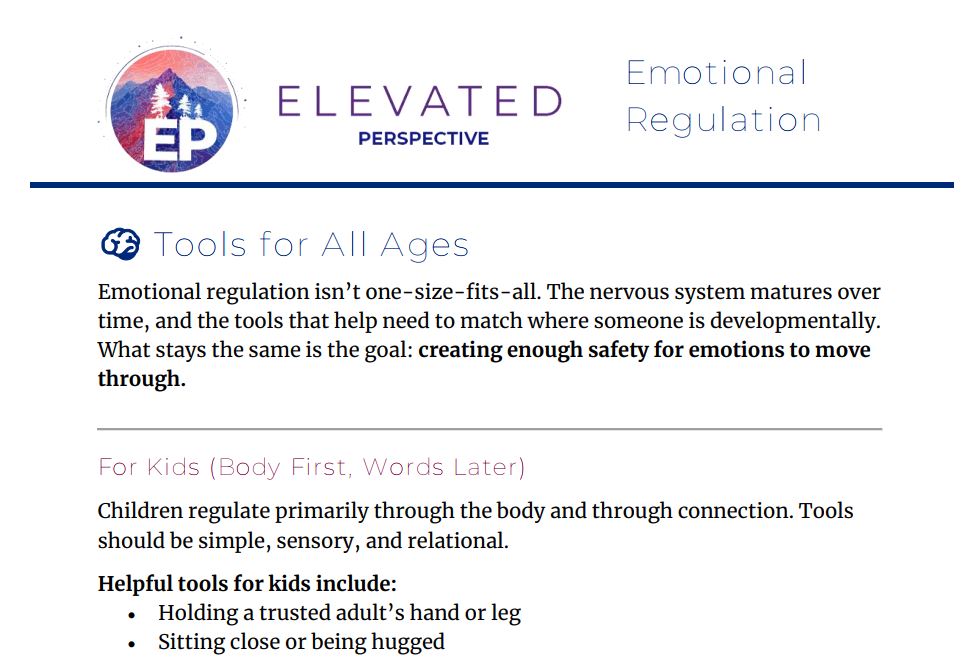
Download the Emotional Regulation Tools for All Ages below. A simple, supportive guide to building steadiness at every stage of life.
4. Practice Regulation in Calm Moments
Regulation strengthens through repetition — not intensity.
Small, consistent practices build capacity:
- Pausing between tasks
- Checking in with the body
- Using compassionate inner language
- Creating predictable rhythms
These moments teach the nervous system that it can move in and out of stress safely.
5. Aim for Progress, Not Perfection
Being regulated doesn’t mean being calm all the time.
It means:
- Noticing sooner
- Recovering faster
- Responding with more choice
- Treating yourself with less judgment
Ups and downs are part of being human. Regulation makes those waves smoother — not absent.

A Closing Thought
Emotional regulation isn’t something we master once and move on from. It’s a living skill that grows through awareness, connection, and practice — across every stage of life.
Throughout this series, the goal hasn’t been to fix emotions or eliminate stress, but to understand how the nervous system works and how safety shapes our ability to respond. When we replace self-judgment with curiosity, regulation becomes more accessible. When we allow support — from others and from ourselves — capacity grows.
Being human means ups and downs. Emotional regulation doesn’t remove those waves; it helps us move through them with more steadiness, compassion, and choice.
And that’s something we can continue to build, at any age.
Explore the Emotional Regulation Series:
- Part 1: What Emotional Regulation Is
- Part 2: Before Self-Regulation Comes Co-Regulation
- Part 3: Why Regulation Breaks Down Under Stress
- Part 4: Strengthening Regulation at Any Age
Building Emotional Regulation Is a Skill
By now, you’ve seen that emotional regulation doesn’t break down because something is wrong — it breaks down because stress changes how the nervous system functions.
Old patterns resurface.
Tools stop working when capacity is low.
Stress builds quietly until the system reaches its limit.
If this is your first post in the series, you may want to begin with Part 1: Emotional Regulation — What It Is, Why It Matters, and How It Evolves, where I lay the foundation for understanding regulation across the lifespan.
This context matters, because how we understand these experiences shapes how we respond to them.s.