
Emotional regulation isn’t something we’re born knowing how to do — and it’s not something we master once and move on from.
It’s a lifelong skill that grows through understanding, connection, and practice.
This series explores what emotional regulation really is, how it develops, why it breaks down under stress, and how we can strengthen it at any age.
What It Is, Why It Matters, and How It Grows With Us
Emotional regulation is one of those terms that gets used a lot — often without much explanation.
It’s not about staying calm all the time.
It’s not about suppressing emotions or “being positive.”
And it’s definitely not about controlling yourself into numbness.
At its core, emotional regulation is about relationship — with your nervous system, your thoughts, your body, and the moment you’re in.
It’s a skill that evolves as we do.
What Emotional Regulation Really Is
Emotional regulation is the ability to notice, experience, and respond to emotions without being overwhelmed by them — or ruled by them.
That includes:
- Recognizing what you’re feeling
- Understanding why it might be happening
- Giving yourself enough internal safety to respond rather than react
Regulation doesn’t mean the emotion disappears.
It means you stay present while the emotion moves through you.
Think of it as learning how to surf waves instead of trying to stop the ocean.

When emotional regulation is strong, people tend to:
- Trust themselves more
- Recover more quickly from stress
- Think more clearly under pressure
- Communicate with less reactivity
- Feel safer in their own bodies
When it’s underdeveloped or disrupted, we often see:
- Anxiety that feels sudden or overwhelming
- Emotional shutdown or numbness
- Explosive reactions that feel “out of character”
- Overthinking, spirals, or people-pleasing
- Difficulty with boundaries or decision-making
This isn’t a character flaw.
It’s information.
Most regulation challenges trace back to how safe we learned to feel — not to willpower or personality.

Humans are not born with the ability to regulate emotions on their own, it’s something that needs to be learned.
Babies rely entirely on co-regulation — the soothing voice, steady presence, and attuned responses of caregivers.
Over time, the nervous system learns:
“When I feel overwhelmed, someone helps me return to balance.”
That pattern becomes internalized.
As children grow, emotional regulation develops through:
- Repeated experiences of being soothed
- Naming emotions
- Learning that feelings are allowed
- Having big emotions met with safety rather than fear or dismissal
If those experiences were inconsistent, rushed, or missing — the nervous system adapts in other ways. Those adaptations often show up later as anxiety, shutdown, or reactivity.
Again, this isn’t something to fix — it’s something to understand.

Emotional regulation is not a finish line you cross in adulthood. It’s a living, evolving process.
In childhood, regulation is mostly external.
In adolescence, emotions intensify while regulation is still under construction.
In adulthood, many people realize they were never taught the skills — only the expectations.
Later in life, regulation can deepen even further as:
- Awareness increases
- The nervous system becomes more familiar
- Old patterns soften
- Self-compassion replaces self-criticism
The beautiful truth is this:
Your nervous system is always capable of learning new responses.

A common misunderstanding is that emotional regulation means not feeling so much.
In reality, healthy regulation increases your capacity to feel — without losing yourself.
It allows you to:
- Stay connected during discomfort
- Pause before reacting
- Feel emotions without turning them into identity
- Move through stress with more flexibility
This is why regulation is foundational to:
- Meaningful relationships
- Mental fitness
- Resilience
- Healing
- Growth
Explore the Emotional Regulation Series:
- Part 1: What Emotional Regulation Is
- Part 2: Before Self-Regulation Comes Co-Regulation
- Part 3: Why Regulation Breaks Down Under Stress
- Part 4: Strengthening Regulation at Any Age
Building Emotional Regulation Is a Skill
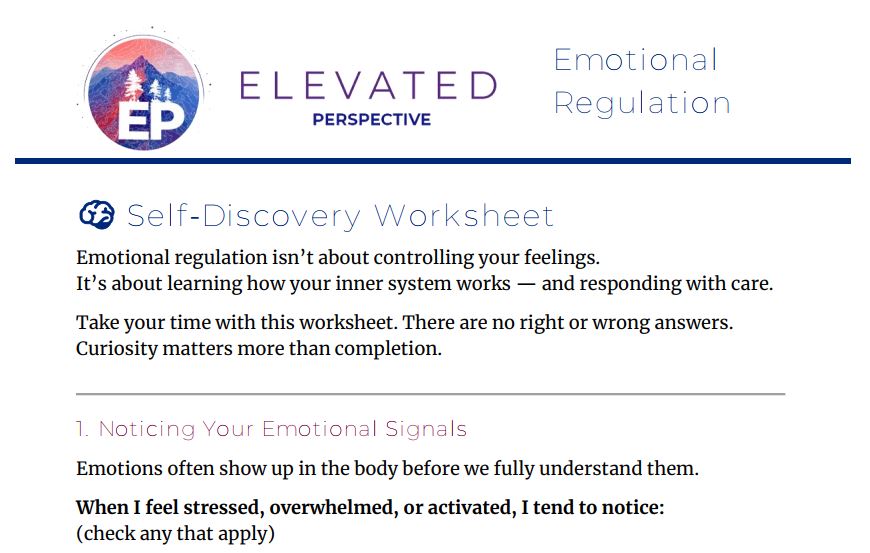
This worksheet is a gentle place to explore how emotional regulation shows up for you. There’s nothing to solve — just space to notice, reflect, and build awareness over time.
Emotional regulation can be strengthened at any age.
Some simple entry points include:
- Learning how your nervous system signals safety and stress
- Understanding the difference between the thinking brain and the feeling brain
- Using breath, movement, and awareness to settle the body
- Practicing curiosity instead of judgment when emotions arise
- Building moments of pause into daily life
Small, consistent practices matter more than big breakthroughs.
A Gentle Reminder
If emotional regulation feels hard, it doesn’t mean something is wrong — it means you’re practicing a skill that takes time, repetition, and care.
It often means:
- Your nervous system learned to protect you
- You adapted to your environment
- You did the best you could with the tools you had
Now, you get to learn new ones.