

identity

When Your Inner Weather Changes Every Five Minutes

A Whole Brain Living approach to understanding yourself

Have you ever heard someone say, “If you don’t like the weather, wait five minutes”?
That’s what thoughts can feel like for most of us.

Our inner world shifts fast. Moods roll in like sudden cloud cover. A memory can change the emotional temperature of a moment. And sometimes you can feel completely different within a single hour without consciously choosing any of it.

It is not that you are inconsistent, too sensitive, or overreacting. It may simply be that different parts of your brain are taking turns leading.

In Whole Brain Living, Dr. Jill Bolte Taylor describes what she calls the Four Characters. These are four distinct patterns of thinking and feeling that arise from the left and right sides of the brain. Each has its own personality, pace, strengths, and priorities.

When we are unaware of this internal dynamic, the shifts can feel confusing or even destabilizing. But when we begin to recognize which character is active, something powerful happens. We gain choice.

The weather inside does not stop changing.
But we stop being surprised by it.
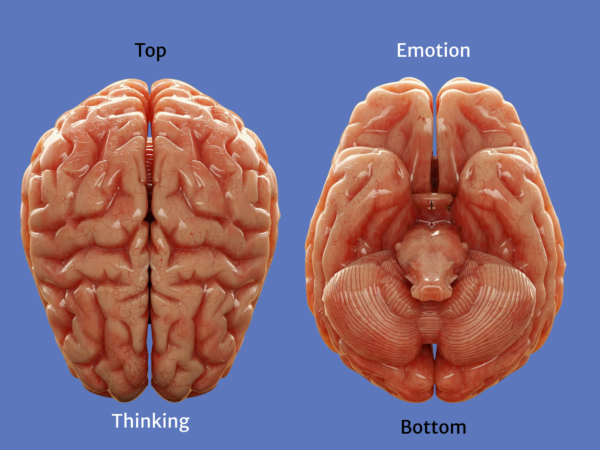
In the image above the brain is separated by thinking on the top and emotion on the bottom of the brain. Ten points for noticing that there are two separate halves as well (This image is for illustrative purposes only and is representation of the human brain).

Your Brain Is a Weather System, Not a Single State

Most of us grow up thinking we should be one consistent version of ourselves at all times.
But in Whole Brain Living by Dr. Taylor, you learn that you are actually a combination of:

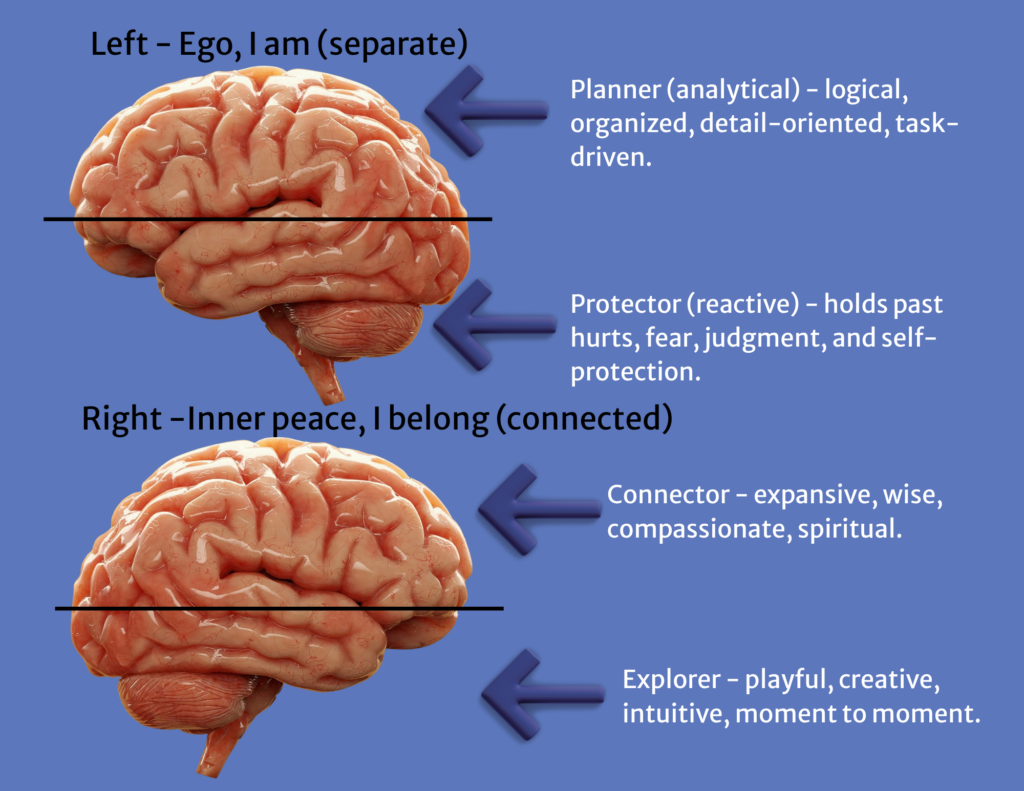
  • Left Thinking (Character 1): The planner, the organizer, the one who loves lists and order.
  • Left Feeling (Character 2): The protector, the one who remembers hurt and tries to keep you safe.
  • Right Feeling (Character 3): The playful, creative, spontaneous energy—your inner child.
  • Right Thinking (Character 4): The calm observer, the expansive, connected, “it’s all going to be okay” presence.

Each part has a purpose. Each part shows up to help.
But when you don’t know who’s driving the bus, your internal weather can feel unpredictable and overwhelming.
Most of the Shifts Happen Before You’re Aware of Them
This is the part many people miss.

Whole brain living isn’t about controlling every thought or emotion—it’s about noticing which “character” just rolled in, just like noticing when the wind changes.

Sometimes:

  • Character 2 storms in because something touched an old wound.
  • Character 1 takes over because you’re overwhelmed and trying to feel in control.
  • Character 3 appears when you’re relaxed and safe.
  • Character 4 softens everything when you slow down long enough to let it speak.

These shifts happen in seconds, and often below conscious awareness.
But once you start recognizing them, you can choose your response rather than getting swept away by the storm.

Why This Matters for Your Everyday Life

When you understand your inner weather system:

  • You stop blaming yourself for being “all over the place.”
  • You recognize when fear, memory, joy, or logic is actually speaking.
  • You learn how to soothe the storm instead of fighting it.
  • You get better at knowing what you need—right now, in this moment.

This is self-awareness in real time.
Not perfection.
Not constant calm.
Just skillfully meeting yourself again and again.

A Simple Practice to Get Started

The next time you notice your inner weather shifting, pause. Think of the Four Characters like guests in a room.

Then gently ask yourself:

“Who just walked in?”

  • Is it the planner?
  • The protector?
  • The playful one?
  • Or the peaceful one?

You do not have to judge the answer. Just notice it.

Then take one slow breath, letting the exhale be slightly longer than the inhale.

That single breath gives your nervous system a moment to settle. It allows another part of your brain to participate before you react.

Naming creates awareness.
Breathing creates space.
Space creates choice.

The weather inside you will still change. That is part of being human.

But when you learn to recognize the shift, you begin to see patterns. You notice transitions. And over time, you learn how to carry an umbrella before the storm hits.

Connect with us to schedule your 75-minute Foundations call and start your path to transformation.

Growing Up, Looking Back: A Fresh Approach to Inner Child Work

Why the child you once were still shapes the adult you are becoming

Most of us don’t realize how much our younger selves are still shaping our adult lives. The worries we carry, the way we react when we feel overwhelmed, and the patterns we fall into without thinking—many of them began long before we were old enough to understand what was happening.

That’s where Growing Up, Looking Back: A Fresh Approach to Inner Child Work really begins.
Inner child work isn’t about “becoming a child again.” It’s about gently reconnecting with the parts of ourselves that were formed during our earliest years—the parts that learned how to cope, how to stay safe, how to earn love, or how to avoid conflict. These younger parts influence our emotional responses today, often without our awareness.

Inner child work helps us slow down, listen, and understand.
And when we do that, something powerful happens: old patterns soften, compassion grows, and we start responding from a grounded, capable place rather than an old protective one.

What Inner Child Work Actually Looks Like

Inner child work is a process of getting deeply curious about the younger parts of you. Together we explore:

  • Where certain beliefs or fears started
  • How childhood experiences shaped your responses today
  • What your younger self needed but didn’t receive
  • What tools you can use now to support those parts

This isn’t about reliving the past. It’s about bringing awareness and compassion to it.

In my approach—which blends Conversational Tranceformation™, Rapid Transformational Therapy (RTT®), and practical coaching—we take a gentle, insight-based path. Each modality works together to help you understand where patterns began, how they still show up today, and how to shift them with clarity and compassion. This integrated style supports both the emotional healing of the inner child and the practical skills needed to create real change in your daily life.

Think of it as having a guide helping you connect the dots between “why this still bothers me” and “what I can do differently now.”

You don’t have to know exactly what you’re looking for. Most people come in simply feeling like something inside them needs attention or soothing—and that’s enough.

Why I’m Deeply Connected to This Work

People often ask why I feel so at home doing inner child work. The truth is:
I’ve spent most of my life working and understanding kids—how they think, feel, cope, and communicate.

A lifetime of working with children

My work with children started at 12, babysitting and supporting families in my community. By 15, I was working in daycare. By my early 20s, I was managing a full daycare program at a ski resort in Alberta.

These years gave me real-world insight into child behaviour and emotional development—insight that deeply informs how I guide adults through their inner child healing.

Formal training in development and psychology

I completed Early Childhood Education through the University of Lethbridge and studied child psychology, providing me with developmental frameworks, attachment theory, emotional regulation patterns, and behavioural understanding.

Experience with teens navigating big emotions

My time at Options for Sexual Health—supporting teens with identity, relationships, boundaries, and difficult emotions—added another layer to my work and taught me how to create safe spaces for vulnerable conversations.

Parenting twins

And of course, being a parent of identical twins has given me a front-row seat to how differently children experience the world—even with the same genetics and environment. Parenting has shaped not only my compassion, but my ability to spot developmental patterns quickly and accurately.

Put all of this together, and you have a blend of intuition, training, lived experience, and emotional depth that makes inner child work natural, grounded, and effective.

Why Inner Child Work Helps So Many Adults

As adults, we often assume we’ve “outgrown” childhood experiences.
But the patterns that formed early don’t disappear—they simply become more sophisticated.

Inner child work helps adults identify when they’re reacting from:

  • Old fear instead of current reality
  • Learned responsibility instead of healthy boundary
  • People-pleasing instead of authentic want
  • Survival strategies instead of choice

When you understand why a reaction exists, you gain the power to interrupt it.
And that shif

If You’re Feeling a Pull Toward This Work… Here’s Why That Matters

Adults are incredibly skilled at ignoring their internal signals.
We shrug off discomfort, call it “stress,” or assume we simply need to work harder, cope better, or “get over it.”

But that quiet pull—the curiosity, the nudge, the sense that something inside you is ready to shift—is meaningful.

It often shows up when:

  • You’re tired of repeating the same pattern
  • You feel like you’ve outgrown an old identity
  • Your nervous system wants more peace
  • A part of you wants to stop bracing for impact
  • You’re finally ready to understand rather than avoid

This is where Growing Up, Looking Back: A Fresh Approach to Inner Child Healing becomes powerful for adults. It gives you the language, tools, and emotional clarity your younger self never had access to.

In my work, using Conversational Tranceformation™, RTT®, and coaching, we approach this gently and collaboratively. You stay grounded. You stay in control. And you build a version of yourself that feels calmer and more aligned with who you want to be—not who you had to be.

You never have to do this work alone.

And if you’re feeling that pull, it’s likely because a part of you already knows—it’s time.

💜

Connect to schedule your 75-minute Foundations call and start your path to transformation.