
Emotional regulation isn’t something we’re born knowing how to do — and it’s not something we master once and move on from.
It’s a lifelong skill that grows through understanding, connection, and practice.
This series explores what emotional regulation really is, how it develops, why it breaks down under stress, and how we can strengthen it at any age.
What Emotional Regulation Looks Like in Kids vs. Adults
Emotional regulation looks very different depending on where we are in development — but the need for safety and connection never disappears.
Emotional regulation looks different in children, teens, and adults because our brains, bodies, and life experiences are constantly evolving.
Children rely on caregivers to help calm their nervous systems, borrowing regulation through closeness, reassurance, and presence.
As we grow, we gradually internalize those experiences and learn to regulate ourselves, though the process is rarely smooth.
Teens often feel emotions more intensely while still building regulation skills, and adults may appear outwardly regulated while internally overwhelmed.
Across every stage of life, emotional regulation is shaped not by age or willpower, but by how safe we feel — in our bodies, in our relationships, and in the moments we’re navigating.
It’s a skill that evolves as we do.
What Co-Regulation Really Means

In Children
Children are not meant to regulate emotions on their own.
Their brains and nervous systems are still under construction, which means they rely on co-regulation — borrowing calm from a trusted adult.
This can look like:
- Crying when overwhelmed
- Meltdowns that seem “out of proportion”
- Clinging, hiding, or needing physical closeness
- Big feelings with very few words
A simple example of co-regulation is:
A child holding onto a parent’s leg in a busy or unfamiliar place.
The child isn’t being dramatic or manipulative.
Their nervous system is saying: “I need your calm to feel safe.”
The parent’s steady presence — voice, body, and reassurance — helps the child’s system settle. Over time, the child learns:
“When I feel overwhelmed, I can return to safety.”
That learning becomes the foundation for self-regulation later in life.

In Teens
Adolescents; teens experience stronger emotions with a still-developing regulation system.
This can look like:
- Intense reactions
- Mood swings
- Pulling away and then needing reassurance
- Big feelings followed by embarrassment or shutdown
They still need co-regulation — it just looks different now. Often it’s:
- Being available without hovering
- Listening without fixing
- Staying calm when emotions spike
Even when they push back, their nervous system is still checking:
“Is it safe to feel this here?”

In Adults
Adults are often expected to self-regulate — even if they were never shown how.
This can look like:
- Overthinking instead of feeling
- Staying “functional” while overwhelmed
- Shutting down emotions to stay in control
- Feeling ashamed of needing support
But adults still benefit from co-regulation too.
It might look like:
- Sitting with someone who feels steady
- Talking something through without being judged
- A calming voice or grounded presence
- Feeling understood rather than corrected
The difference is that adults are often taught to ignore this need — not because it disappears, but because it’s expected to.
Many of us grew up hearing messages like “calm down,” “figure it out,” “don’t be so sensitive,” “you’re fine,” or “handle it yourself.”
Over time, those messages teach us to manage emotions privately, minimize what we feel, or push through rather than reach for connection — even when our nervous systems are still asking for support.

Co-Regulation, Simply Explained
Co-regulation means:
Using connection with another person to help your nervous system settle.
Before we can calm ourselves, we learn how to calm with someone else.
For a child, that might be:
- Holding a parent’s leg
- Being picked up
- Hearing a familiar voice
For a teen, that might be:
- Sitting in the same room without needing to talk
- Being listened to without immediate advice or fixing
- Knowing a trusted adult is available, even if they don’t engage right away
For an adult, it might be:
- A supportive conversation
- A quiet moment with someone you trust
- Feeling emotionally seen
Eventually, those experiences become internalized — and we carry that steadiness inside us.

A Gentle Reminder
Emotional regulation can feel hard, it doesn’t mean something is wrong — it means you’re practicing a skill that takes time, repetition, and care.
It often means:
- Your nervous system learned to survive in the best way it knew how
- You adapted the best you could
- You’re now ready to learn new ways of feeling safe
Regulation is about having enough safety — inside and out — to meet what arises.
Explore the Emotional Regulation Series:
- Part 1: What Emotional Regulation Is
- Part 2: Before Self-Regulation Comes Co-Regulation
- Part 3: Why Regulation Breaks Down Under Stress
- Part 4: Strengthening Regulation at Any Age
Building Emotional Regulation Is a Skill
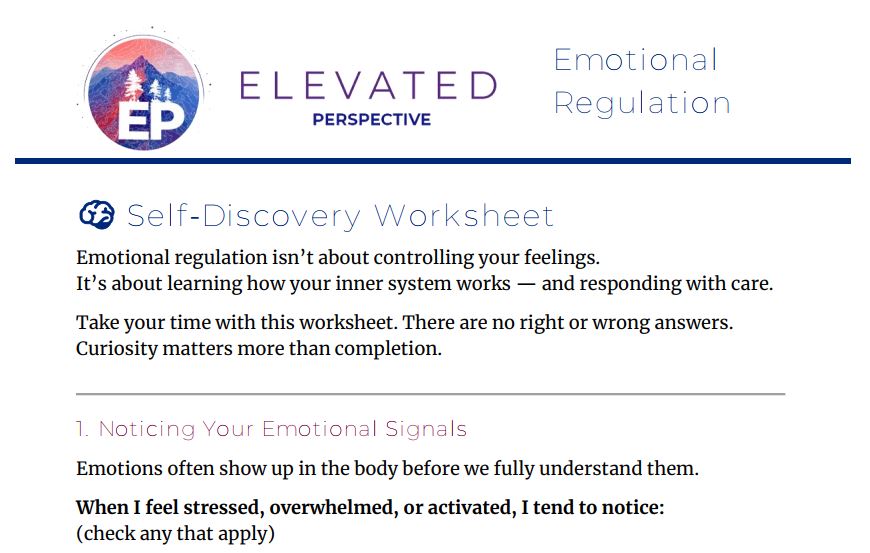
This worksheet is a gentle place to explore how emotional regulation shows up for you. There’s nothing to solve — just space to notice, reflect, and build awareness over time.
Emotional regulation can be strengthened at any age.
Some simple entry points include:
- Learning how your nervous system signals safety and stress
- Understanding the difference between the thinking brain and the feeling brain
- Using breath, movement, and awareness to settle the body
- Practicing curiosity instead of judgment when emotions arise
- Building moments of pause into daily life
Small, consistent practices matter more than big breakthroughs.