
Rethinking self-care as a daily practice of how you treat yourself
Self-care gets talked about a lot these days.
It seems that somewhere along the way, it became something we do, like a day off.
Or something we buy like a manicure, a book, a car.
Those things can be enjoyable, and they can be part of your life, but what I see with clients is that self-care often gets misunderstood.
Because real self-care isn’t an occasional appointment or a material item.
It’s not something you do once in a while, it’s a practice in everyday life.
Self-care is the relationship you have with yourself.
At its core, self-care is
Treating yourself like someone you love deeply.
So, let’s make this real.
Bring to mind someone you love and care about.
Take a moment and really picture them.
See their face.
Notice the small details—the way they look when they’re tired, or overwhelmed, or just not quite themselves.
Imagine they’ve had a hard day.
Their shoulders are a little heavier.
Their energy is low.
Something feels off.
How do you respond?
- Do you rush them?
- Tell them to push through?
- Ignore what they’re feeling?
Or do you become softer towards them?
Do you slow down your voice to give them space to take a breath?
Do you pay closer attention?
You notice what’s happening, you adjust to their needs. Not because you have to, but because you want to.
Because they matter to you.
That is care.
And yet, so many of us don’t offer that same level of attention, patience, and kindness to ourselves.

Why Self-Care Can Feel So Hard
If self-care sounds simple but feels difficult, you’re not alone.
Many people struggle with how to take care of themselves, it’s a skill to learn, we aren’t taught.
If you’ve ever thought:
- Why do I keep doing this?
- Why can’t I just change?
- Why does this feel so hard?
It’s not because you’re broken.
It’s because it’s hard to see clearly from inside your own experience.
And even when you begin to see it, change takes practice.
It will feel messy and unfamiliar and likely uncomfortable at first.
That’s not failure, that what learning is like.
With repetition, what feels awkward begins to feel natural.
And over time, you start to recognize your patterns, understand your responses, and choose differently.

Early Experiences Shape How We Relate to Ourselves
Here’s something important to understand:
So much of how you treat yourself was learned long before you were aware of it.
As children, we are constantly taking in information through tone, response, connection, and experience.
We learn:
- how to respond to stress
- how to interpret emotions
- how to get our needs met
- and how to relate to ourselves
Much of this learning happens implicitly, which means you don’t remember learning it, but it continues in how you think, feel, and respond today.
If you were spoken to harshly, that tone can become your inner voice.
If your needs were dismissed or overlooked, you may have learned to minimize them yourself.
If connection felt uncertain or conditional, you may have adapted by overperforming, people-pleasing, withdrawing, or staying hyper-aware of others.
At the time, these weren’t problems, they were intelligent adjustments. They helped you navigate your environment; they helped you belong, they helped you get through.
But what helped you then, may not support you now.
This is where self-care becomes something much deeper, because it isn’t just about what you do, it’s about how you relate to yourself differently.
It starts with noticing the patterns, understanding where they came from and practicing new ways of responding.
These patterns are learned just like you learned as a child.
And what is learned… can be relearned.
Self-care is often thought of as something you do, but I’ve come to understand it as something very different.
It’s a practice. A moment-to-moment relationship with yourself.
For years, my inner dialogue was incredibly severe. It was self-talk that showed up the moment I made a mistake and I didn’t even realize how mean it was. It just felt normal.
Until I started noticing some of those thoughts that I heard myself say out loud.
My friends were horrified on my behalf because that wasn’t their experience of me at all.
To them, I was accepting, supportive, and kind.
But inside my own mind? Not even close. And that was a turning point. I began to see that I was offering others something I wasn’t offering myself.
When I was introduced to the idea that I could relate to myself differently, I could be my own best friend, that I could be kind to myself, what a gift.
That, to me, is where self-care truly begins.
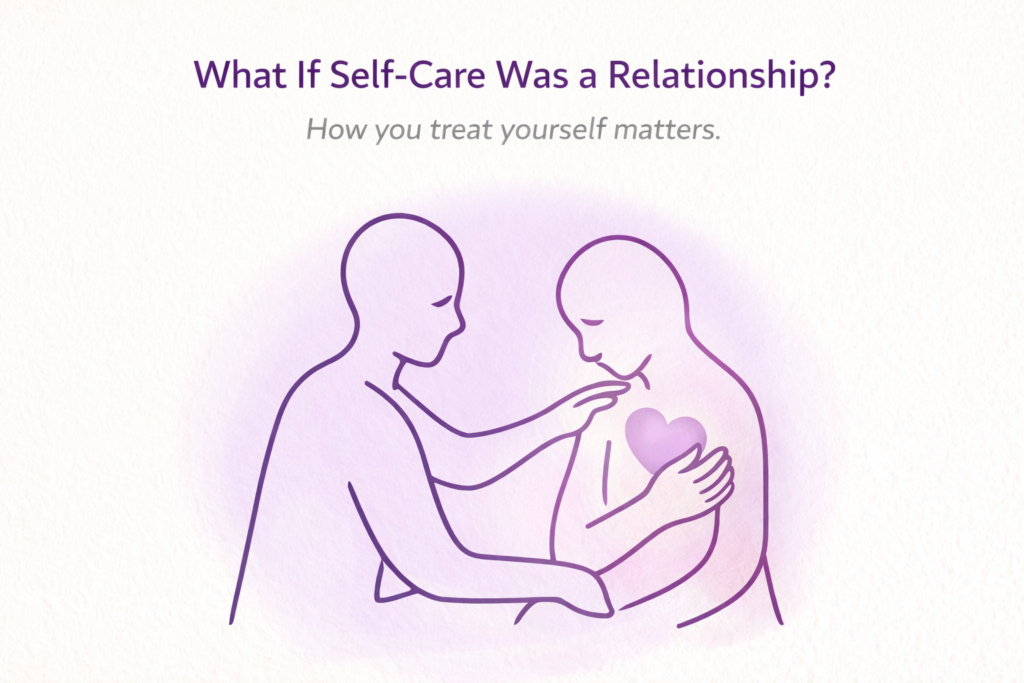

Self-respect needs to show up in the smallest, most ordinary moments, everyday.
- In what you say to yourself after a mistake.
- In how you respond when you feel overwhelmed.
- In whether you push through… or pause and listen.
One way to begin practicing this is through awareness.
Before words leave your mouth, you have the power to take a breath and then pause and ask:
Does what I’m about to say to myself sound like something I would say to a person I love?
If the answer is no:
You pause, take a breath to notice what’s going on.
Ask yourself: What’s the quality of that thought? Kind or Critical?
If it’s Critical choose something different, choose kindness.
This is not about perfection. It’s a practice of awareness that you can choose.
We are imperfect beings who have been taught to reach for the unattainable. We have a choice in how we respond to ourselves.
Your amazing brain is designed to intentionally choose which part of the brain is leading. By working with both the conscious and unconscious parts of your mind, you have the ability to think about your thinking.
Want to learn more? See the blog on Whole Brain Living: When Your Inner Weather Changes Every Five Minutes
Self-care isn’t selfish, it’s foundational.
It’s how you show yourself
that you matter,
that you’re worthy of care,
that you are someone you choose to love.
From there, you begin to experience life differently because the change is happening from the inside out.
What If Self-Care Was a Relationship?
What if self-care wasn’t something you did once in a while, but something you practiced in how you treat yourself every day? This worksheet is a place to start noticing, understanding, and responding to yourself in a more supportive way.