
Reconnecting with love, even when it feels unfamiliar
There’s a pattern I see in so many of my clients, they don’t struggle to give, they struggle to receive.
What I mean by that is there’s a kind of rejection, a feeling of being less than or lacking.

It’s something that makes them squirm in their seat, shrug a shoulder, or cave in on themselves.
They turn their head away. They rub their arms up and down in self-comfort.
These are all signals to me that receiving the love they rightfully deserve
is really uncomfortable… and unfamiliar.
And it’s not because they don’t want it.
It’s because somewhere along the way, they learned they had to earn love, support, kindness, even space.
If love wasn’t something you could fully feel or trust, your nervous system adapted.
You learned to:
- perform
- achieve
- be helpful
- stay in control
These are all ways of trying to get something that was not known to be given; love, connection, and a sense of being enough.
This is not about blaming caregivers, parents or the past, but recognizing that this is an emotional language many people were never taught.
So when a feeling of love or support or appreciation is offered to you freely it can feel unfamiliar even uncomfortable.
Not because it’s wrong but because it’s new.
What Happens When You Can’t Receive
When receiving isn’t something that feels available to you, often without realizing it, it can show up as:

- overgiving
- over-functioning
- overthinking
This is an effort to create externally what feels unfamiliar internally.
Love turns into effort and worth turns into performance.
Connection turns into responsibility and it’s exhausting.
We say we want love.
We want to feel supported.
We want to be seen.
But when it’s offered we can deflect it or minimize it or push it away.
Someone says, “You did a great job,”
and we respond with, “It was nothing.”
Someone offers to help,
and we say, “No, I’ve got it.”
We’re given time to rest and we feel guilty like we should be doing something more productive instead.
It’s so confusing when we notice it.
Terry Real, a psychotherapist known for his work on relationships, talks about how many of us are shaped by a culture of extreme individualism.
We’re taught to:
- be self-sufficient
- not need too much
- handle things on our own
- prove our worth through effort
And while that can look like strength it often disconnects us from something essential.
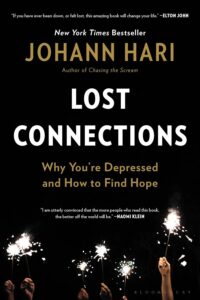
Johann Hari, an author and researcher, describes this in a different way.
He explains how many of the struggles we experience are rooted in disconnection.
Disconnection from:
- each other
- meaningful work
- our environment
- and even ourselves
Some people call this separation sickness.
Not because something is wrong with us but because something is missing.
Sometimes, that missing piece isn’t obvious.
Elizabeth Gilbert, an author known for exploring personal growth and self-discovery, shares an idea that resonates deeply.
Some people remember what love felt like in their childhood and others don’t.
They don’t remember the feeling of it they just remember that something was missing.
Often, they didn’t realize what was missing was love.


Twenty years after Eat Pray Love, Elizabeth Gilbert is sharing something much more personal.
She’s launched a Substack called Letters From Love—
a daily practice of writing to herself from a place of unconditional love.
And what’s interesting about this is how unfamiliar that can feel for so many of us.
Most of us have heard the phrase,
“You can’t love someone else until you love yourself.”
In this video, Terry Real explores the deeper layers of self-esteem, shame, and self-compassion.
And what it really looks like to hold yourself with warmth… even when it’s hard.
“You’re a human being with unmet needs,” Johann Hari says.
And that one sentence shifts everything.
Because instead of asking,
“What’s wrong with me?”
It invites a different question:
“What might be missing?”
When you combine disconnection with individualism, something subtle happens. Worth becomes something you prove instead of something you are.
That means that receiving can feel uncomfortable. Because if love, support, or kindness comes without effort, it challenges everything you’ve learned about how personal value works.
Most people don’t walk around thinking,
“I have a problem receiving.”
They just feel:
- tired
- on edge
- over-responsible
- unable to relax even when nothing is wrong.
They might notice:
- compliments feel uncomfortable
- rest feels unearned
- asking for help feels hard
- they’re always the one holding everything together
But they may not connect it to worth or worthiness.
Why We Need to Practice This
Awareness alone doesn’t shift this pattern of being able to receive.
You can understand it and still feel uncomfortable when someone says:
“I appreciate you.”
Because if worth has always been something you earn, then receiving it freely can feel unfamiliar and unsafe.
But that doesn’t mean it’s wrong.
It usually means you’re learning to experience worth and worthiness in a new way.
That’s Why This Practice Matters
Because you can’t fully feel love if you don’t know how to receive it.
Most people were never taught how to.
So instead of trying to figure it out all at once you can start by practicing it in small, simple ways.
You’ll find a simple guide below. 💜
💜 Receiving Practice
A way to continue this work in your everyday life
1. The Pause
Next time something is offered to you:
- A compliment
- Help
- Kindness
- Time
- Space
Pause.
Notice your first instinct.
- Do you deflect?
- Minimize?
- Rush past it?
Just notice.
2. Let It Land (5% More)
Instead of pushing it away, try this:
Say:
“Thank you.”
And let it land… just 5% more than you normally would.
That’s enough (it’s a practice ;).
3. Get Curious
Afterward, gently ask yourself:
- What felt uncomfortable about receiving that?
- What did I want to say instead?
- What would it mean if I actually let that in?
No judgment.
Just awareness.
4. Love Letter Practice (Optional)
Write a few lines to yourself from Love.
You can:
- write in your own voice
- borrow the voice of someone you trust
- or simply start with: “I’m here.”
It doesn’t have to feel natural.
It just has to begin.
5. Step Into the Version of You Who Can Receive
Elizabeth Gilbert suggests imagining the version of you who can receive.
When something is offered ask:
- What would it be like to accept this?
You can even practice through fiction—notice characters who receive love, support, or care, and imagine yourself in their place.
You don’t have to believe it yet.
Just let yourself experience it even for a moment.
6. Repeat
This isn’t something you figure out once.
It’s something you practice.
Moment by moment.
- Receiving
- Softening
- Allowing
It’s about giving your system a felt experience of what receiving could be like.