
Imagine if fear could speak.
It might say:
“I know you don’t always like me.
I know you wish I would go away.
But I’ve spent your entire life trying to keep you safe.
Sometimes I get it right.
Sometimes I overreact.
Sometimes I mistake an uncomfortable conversation for a life-threatening situation.
But everything I do comes from one place: protection.”
The problem isn’t that I exist.
The problem is that, in the modern world, I’ve been asked to do a job I was never designed to do.
In Part 1 of the Fear Series – What Fear Really Looks Like, we explored how fear disguises itself and how our thoughts can keep an emotional reaction alive. But where does fear belong in our daily lives?
A Protector Living in a Different World
The challenge is that our protector was designed for a world that looked very different from the one we live in today.
Thousands of years ago, fear helped us survive immediate physical danger.
A predator, a poisonous snake, an approaching storm, an enemy tribe.
The danger was real, immediate, and usually short-lived.
Today, our protector is often responding to very different kinds of threats in the modern world.
- A difficult email.
- Critical feedback.
- A social media comment.
- A disagreement.
- Being left out.
- Making a mistake.
- Starting something new.
- Public speaking.
- The possibility of rejection.
To our brain and nervous system, these experiences can feel surprisingly similar.
Not because they actually threaten our lives… but because they may threaten something else we’ve learned to protect:
Our belonging.
Our identity.
Our sense of worth.
This is where Dr. Jill Bolte Taylor’s model of the four parts of the brain becomes incredibly helpful…
Dr. Jill Bolte Taylor’s Whole Brain Living framework offers a simple way to understand what may be happening inside us when fear shows up.
She describes the brain as having four main “characters”:
- the left thinking brain – logic, planning, words & language,
- the left emotional brain – fear, anger, self-judgement, anxious,
- the right emotional brain – compassion, playful, curious,
- the right thinking brain – calm, helpful, generous.
From now on we’ll refer to them as your Survival Team and your Growth Team.
Survival Team
- 🛡️ Protector (Left Emotional)
- 🧠 Thinker (Left Thinking)
Growth Team
- ❤️ Heart (Right Emotional)
- ✨ Visionary (Right Thinking)
In this model, fear is often connected to the left emotional brain, the Protector, which she describes as the part of us wired for fight, flight, or freeze.
This part is not trying to ruin our lives. It is trying to protect us, often by comparing what is happening now to something we have experienced before.
This is why fear can feel so convincing. The present moment may only hold a comment, a facial expression, a decision, a deadline, or a small uncertainty — but the Protector may connect it to an old story of rejection, failure, shame, danger, abandonment, or not being good enough.

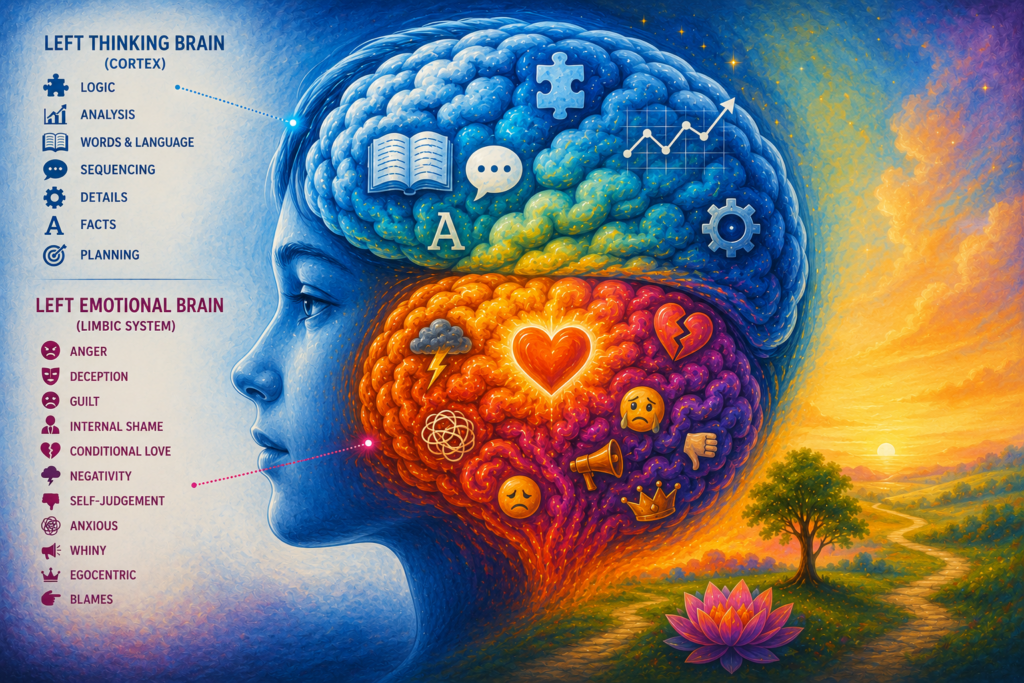
🛡️ The Protector
The Protector is not bad. Its fear, anxiety, anger and other powerful emotions aren’t our enemies. They carry information and help us recognize, learn from and respond to our experiences. But when fear is activated, it can narrow our view and make something happening now feel connected to something that happened before.
Every second of every day, this part of the brain, along with the body, is asking one important question:
“Am I safe?”
It’s comparing what is happening right now with everything you’ve experienced before.
- Have I felt this before?
- Did this end badly?
- Should I be careful?
- Do I need to protect us?
It does all of this in less than fraction of a second, often before we’re even aware it’s happening.
Isn’t that incredible?
Without this part of our brain, our ancestors wouldn’t have survived.
They needed a system that could instantly recognize danger and prepare the body to respond.
Fear isn’t a mistake.
Fear is a gift.
When the Protector sounds the alarm, it has a very capable teammate ready to help.
🧠 The Thinker
The Thinker analyzes, organizes, plans, remembers details and solves problems. When the Protector says, “Something might be wrong,” the Thinker naturally wants to figure out why and what to do about it.
The Protector sounds the alarm. The Thinker tries to solve the problem.
We’ve become exceptionally good at using this part of ourselves. Much of Western culture rewards analyzing, planning, productivity, achievement and getting the right answer.
These are valuable resources.
But they’re not the only resources available to us.
That’s only part of the story.
Meet Your Growth Team
If we stop here, it can feel as though fear is in charge. Fear can keep us tethered to old stories, sometimes responding to what was rather than what is.
As we begin to recognize those stories, we can loosen fear’s grip. Like a balloon released from its tether, we create room to rise into greater freedom, perspective, and trust.
But we’re not leaving our Survival Team behind.
We’re adding more resources to the conversation.
We have two other incredible parts of ourselves available to us:
❤️ The Heart — Right Emotional Brain
✨ The Visionary — Right Thinking Brain
Together, I’m going to call them our Growth Team.

Where our Survival Team helps us protect, analyze, plan and respond to potential danger, our Growth Team opens us to a different set of resources.
Connection. Compassion. Curiosity. Creativity. Intuition. Perspective. Awe. Wonder. Play. Possibility.
These aren’t frivolous extras we earn once all the serious work is done. They are valuable human capacities that can change how we experience and respond to the very same situation.
Our Heart helps us experience the present moment through connection, compassion, empathy and belonging.
Our Visionary helps us step back and see the bigger picture through curiosity, imagination, creativity and possibility.
And this is where things get interesting.
The goal isn’t to replace one team with the other.
It’s to have access to the whole team.

Understanding why fear exists changes our relationship with it.
We don’t need to get rid of our Protector. We don’t need to stop thinking. And we certainly don’t need to become fearless.
We need to learn how to recognize who’s leading the conversation—and remember that we have an entire team of resources available to us.
But understanding something and living it are two very different things.
So how do we actually do that?
How do we catch ourselves when fear takes over?
How do we pause long enough to invite compassion, curiosity, perspective and possibility back into the conversation?
And perhaps most importantly, how do we learn to trust ourselves when we don’t know what’s going to happen next?
That’s where we’re going next.
Part 3: From Fear to Self-Trust
Learning to trust not that everything will go according to plan, but that we have what we need within us to meet what comes.
Explore the Fear Series:
- Part 1: What Fear Really Looks Like
- Part 2: Fear As A Gift
- Part 3: From Fear to Self-Trust
- Part 4: Living Beyond Fear