
emotional intelligence

The Emotional Regulation Series Part 4: Practical Tools for Building Regulation at Any Age

Emotional regulation isn’t something we’re born knowing how to do — and it’s not something we master once and move on from.
It’s a lifelong skill that grows through understanding, connection, and practice.
This series explores what emotional regulation really is, how it develops, why it breaks down under stress, and how we can strengthen it at any age.

The Practice of Growing Emotional Regulation

By now, you’ve seen that emotional regulation doesn’t break down because something is wrong — it breaks down because stress changes how the nervous system functions.

Old patterns resurface.
Tools stop working when capacity is low.
Stress builds quietly until the system reaches its limit.

If this is your first post in the series, you may want to begin with Part 1: Emotional Regulation — What It Is, Why It Matters, and How It Evolves, where I lay the foundation for understanding regulation across the lifespan.

This context matters, because how we understand these experiences shapes how we respond to them.

Emotional Regulation Over Time

Why Old Patterns Still Show Up

Under pressure, the nervous system reaches for what’s familiar, not what’s ideal.

Old patterns — people-pleasing, shutting down, anger, avoidance, control — were once adaptive responses. They helped you cope at a time when your system needed protection. When stress rises, those pathways are simply easier to access.

This doesn’t mean you’re back at the beginning.
It means your system is responding with what it knows.

The goal of regulation work isn’t to eliminate these patterns, but to recognize them sooner and respond with more choice.

Why Tools Don’t Work When You’re Already Overwhelmed

Many people blame themselves when coping tools fail under stress. In reality, this is a timing issue, not a skill issue.

Tools require:

  • Attention
  • Choice
  • Flexibility

High stress reduces all three.

This is why emotional regulation isn’t built in the middle of overwhelm. It’s built around it — during calmer moments, recovery phases, and everyday life. Over time, those practices increase capacity, so stress has less impact when it does arise.

Regulation is not about controlling peak moments.
It’s about recovering more gently and more quickly.

Why Cumulative Stress Changes Everything

Stress rarely comes from one dramatic event. It builds through layers:

  • Interrupted sleep
  • Emotional labour
  • Constant decision-making
  • Uncertainty
  • Transitions
  • Holding things together for others

The nervous system experiences this as total load.

This is why people often say, “Nothing big happened — I just couldn’t cope.”

Something did happen. Capacity was exceeded.

Understanding cumulative stress helps us stop minimizing our experience and start respecting our limits

Building Emotional Regulation Over Time

Emotional regulation isn’t a single tool or technique — it’s a skillset that develops gradually through awareness, repetition, and safety.

The most effective tools work with the body, not against it.

1. Build Awareness Before Action

Regulation begins with noticing:

  • Early stress signals
  • Emotional patterns
  • Body sensations

Awareness creates choice — even when emotions are strong.

This is why reflection tools, journaling, and gentle check-ins matter. They help you recognize what’s happening before the system is overwhelmed.


2. Use Body-First Regulation

When stress rises, the body leads.

Helpful supports include:

  • Slowing the breath
  • Feeling contact with the ground or a chair
  • Gentle movement or stretching
  • Reducing sensory input
  • Restoring rhythm through routine

These approaches create safety first — which allows thinking and emotion to follow.


3. Normalize Co-Regulation at Every Age

Humans regulate better with support.

For children, this might be physical closeness.
For teens, it might be calm presence without pressure.
For adults, it might be conversation, shared space, or feeling understood.

Needing connection doesn’t mean you’re dependent.
It means your nervous system is human.

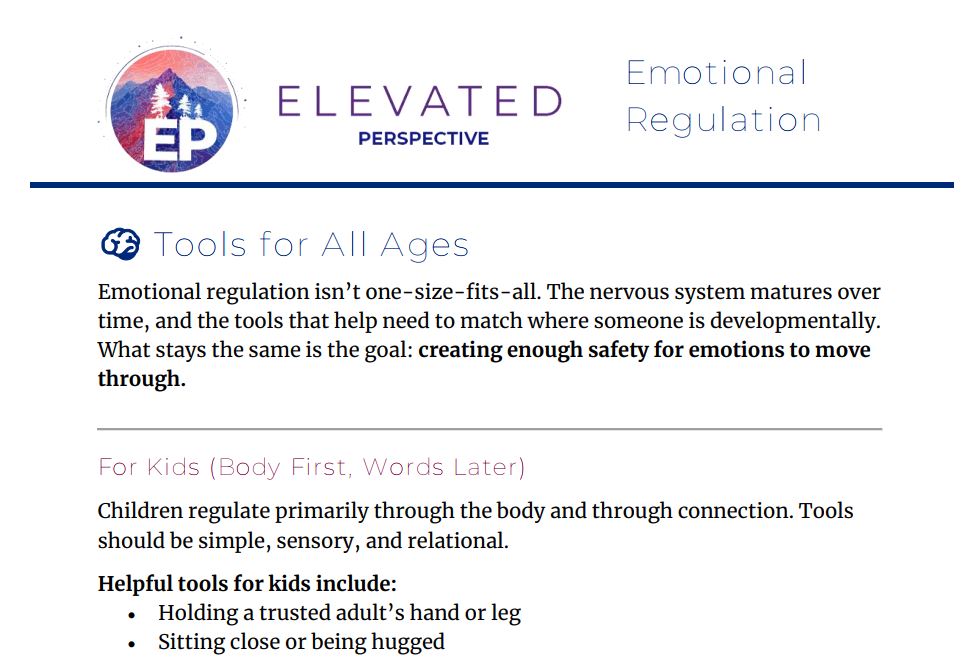
Download the Emotional Regulation Tools for All Ages below. A simple, supportive guide to building steadiness at every stage of life.


4. Practice Regulation in Calm Moments

Regulation strengthens through repetition — not intensity.

Small, consistent practices build capacity:

  • Pausing between tasks
  • Checking in with the body
  • Using compassionate inner language
  • Creating predictable rhythms

These moments teach the nervous system that it can move in and out of stress safely.


5. Aim for Progress, Not Perfection

Being regulated doesn’t mean being calm all the time.

It means:

  • Noticing sooner
  • Recovering faster
  • Responding with more choice
  • Treating yourself with less judgment

Ups and downs are part of being human. Regulation makes those waves smoother — not absent.

A Closing Thought

Emotional regulation isn’t something we master once and move on from. It’s a living skill that grows through awareness, connection, and practice — across every stage of life.

Throughout this series, the goal hasn’t been to fix emotions or eliminate stress, but to understand how the nervous system works and how safety shapes our ability to respond. When we replace self-judgment with curiosity, regulation becomes more accessible. When we allow support — from others and from ourselves — capacity grows.

Being human means ups and downs. Emotional regulation doesn’t remove those waves; it helps us move through them with more steadiness, compassion, and choice.

And that’s something we can continue to build, at any age.

Explore the Emotional Regulation Series:

Building Emotional Regulation Is a Skill
By now, you’ve seen that emotional regulation doesn’t break down because something is wrong — it breaks down because stress changes how the nervous system functions.

Old patterns resurface.
Tools stop working when capacity is low.
Stress builds quietly until the system reaches its limit.

If this is your first post in the series, you may want to begin with Part 1: Emotional Regulation — What It Is, Why It Matters, and How It Evolves, where I lay the foundation for understanding regulation across the lifespan.

This context matters, because how we understand these experiences shapes how we respond to them.s.

Connect with us to schedule your 75-minute Foundations call.

The Emotional Regulation Series Part 3: Why Emotional Regulation Breaks Down Under Stress

Emotional regulation isn’t something we’re born knowing how to do — and it’s not something we master once and move on from.
It’s a lifelong skill that grows through understanding, connection, and practice.
This series explores what emotional regulation really is, how it develops, why it breaks down under stress, and how we can strengthen it at any age.

Why Does This Keep Happening?

If you’ve ever thought, “I know what to do — so why can’t I do it right now?” you’re not alone.

Under stress, many people notice that their best coping skills seem to disappear. They react more quickly than they want to, feel overwhelmed by small things, or fall back into old patterns they thought they’d outgrown. This can be confusing and discouraging, especially for people who have done a lot of self-work.

It’s tempting to interpret this as failure or regression — but what’s actually happening is much simpler and much more human.

Stress doesn’t erase growth.
It temporarily changes how the nervous system operates.

When pressure increases, your system isn’t asking, “What’s the most thoughtful response?”
It’s asking, “Am I safe right now?”

Understanding this shifts the experience from self-blame to self-awareness — and that shift alone is regulating.

Stress Is a Nervous System State, Not a Personality Trait

Stress is not a flaw, a weakness, or a sign that you’re “bad at coping.”
It’s a state of the nervous system.

When stress rises, the body moves into protection mode automatically. This can happen in response to emotional strain, uncertainty, conflict, overload, or even prolonged busyness. The response is fast, instinctive, and not conscious.

This is why stress can show up as:

  • Snapping at people you care about
  • Freezing when decisions need to be made
  • Avoiding conversations you normally handle well
  • Overthinking simple choices
  • Feeling emotionally flat or shut down

These responses aren’t chosen — they’re protective. life.

Common Stress Myths

Myth: “If I were emotionally regulated, this wouldn’t affect me.”
Reality: Regulation doesn’t prevent stress responses — it supports recovery.

Myth: “I should be able to handle this by now.”
Reality: Stress capacity changes depending on context, load, and support.

Myth: “Other people seem fine — why am I not?”
Reality: You’re seeing behaviour, not nervous system state.

Stress doesn’t say anything about who you are.
It tells you what your system is responding to.

What Happens in the Brain Under Stress

When stress increases, the brain and nervous system shift priorities.

Energy moves away from areas responsible for reflection, planning, and emotional nuance, and toward areas focused on survival. This isn’t a malfunction — it’s an ancient design meant to keep humans alive.

You might notice:

  • Thinking becomes more rigid or black-and-white
  • Emotions feel bigger and harder to manage
  • Logic feels out of reach
  • Reactions happen faster than awareness

A helpful way to think about this is that the brain goes into emergency mode. When that happens, there’s less capacity for:

  • Perspective-taking
  • Patience
  • Creative problem-solving

This is why “just calm down” doesn’t work — and why trying to reason with yourself mid-stress often feels impossible.

Real-Life Examples

  • A parent who is usually patient suddenly feels overwhelmed by a small request at the end of a long day.
  • A teen who understands their emotions still shuts down during conflict.
  • An adult who communicates well at work freezes when emotions are involved at home.

In each case, the nervous system isn’t failing — it’s prioritizing safety.

And the most important thing to remember is this:

You can’t think your way out of a state your body is in.

Regulation returns not through effort or control, but through restoring a sense of safety — something we’ll explore more deeply as this series continues.

What Support Can Look Like When the System Is Overwhelmed

When emotional regulation breaks down, the instinct is often to try harder — to fix, control, or push through. But regulation doesn’t return through effort alone. It returns through safety.

This is where it helps to shift away from asking “What should I do right now?” and toward “What does my system need to feel steadier?”

For many people, the most helpful starting point isn’t another technique — it’s awareness. Understanding how stress shows up for you, how your body responds, and what patterns emerge under pressure creates the foundation for change.

When old patterns tend to resurface under pressure or when stress rises, the nervous system reaches for what’s familiar, not what’s ideal.

In Part 4: Practical Tools for Building Regulation at Any Age, we’ll explore how regulation can be strengthened over time — gently, intentionally, and in ways that meet you where you are.

A Personal Note: When Stress Had No Other Way Out

Looking back now, I can see that there was a long period of my life when my nervous system was under constant stress — and I didn’t yet have the language or tools to understand what was happening.

Emotional regulation wasn’t just difficult — it was something I didn’t know existed.

My emotional vocabulary was very small. Like Brené Brown describes in Atlas of the Heart, I only had access to a few labels: mad, sad, or happy. When emotions showed up that didn’t fit neatly into those categories, my system had nowhere to put them. They came out sideways — as anger or as collapse.

Anger looked like rage over small things.
Sadness looked like days in bed, “sick,” withdrawn, and heavy.

My family even had a nickname for the rage — the witchy bitchy woman. She was scary. Honestly, she was scary even to me.

At the time, I didn’t know I was dysregulated. I didn’t know my nervous system was overloaded. I didn’t even know I could feel emotions in my body. The only sensations I recognized were attached to anger — tightness, heat, tension. Everything else felt numb or invisible.

Stress kept building with no release.

Eventually, my body forced a pause. I developed shingles in my ear — Ramsay Hunt syndrome — which paralyzed half my face. What followed was deep exhaustion and depression, which I initially blamed on the medication I was taking. Looking back now, I can see how profoundly overwhelmed my system had become.

By chance — and timing — I went to see an acupuncturist who suggested yoga.

That suggestion changed everything.

Yoga helped me feel my body for the first time — not as something working against me, but as something I could listen to. I began to notice sensations without needing to label or explain them. From there, I slowly started to recognize that different emotions lived in different places.

Over time, patterns became clear:

  • Hyper-tension in my body
  • Grinding and gritting my teeth
  • “Sleeping stress” that never felt restful
  • Pain in my hands and feet

All of it was communication. My body had been expressing what my mind didn’t yet have language for.

As I learned more about how the mind works — especially the harsh, critical things I used to say to myself — I stopped treating my body like the enemy. I began to befriend it. Slowly, my mind, body, and spirit started working together instead of fighting each other.

Ten years later, my emotional world is much richer. There’s nuance now. There’s choice. There’s awareness. Not perfection — I’m human — but far more calm and steadiness than before.

And that’s the part I want to emphasize:

Emotional regulation didn’t arrive all at once.
It came through practice, curiosity, and learning to listen — especially when stress was loud.

If stress brings old patterns back online for you, it doesn’t mean you’re failing. Sometimes it means your system learned one way to cope — and is now ready to learn another.


Understanding stress through the body changed everything for me — and it’s why I believe so deeply that awareness is where regulation begins.

I share this not because everyone’s story looks like mine, but because stress often shows up long before we recognize it as stress. When emotional regulation breaks down, it’s often the nervous system asking for a different kind of support.

Explore the Emotional Regulation Series:

Building Emotional Regulation Is a Skill

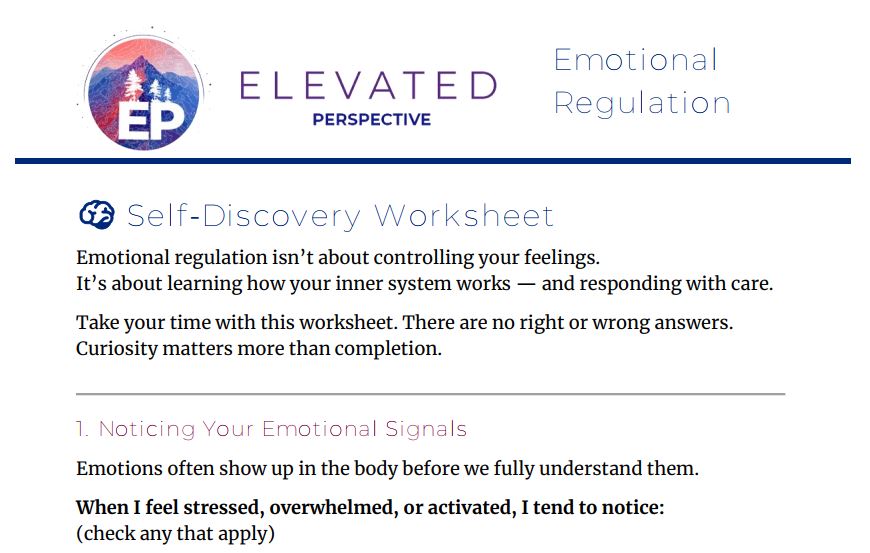
This worksheet is a gentle place to explore how emotional regulation shows up for you. There’s nothing to solve — just space to notice, reflect, and build awareness over time.

Emotional regulation can be strengthened at any age.

Some simple entry points include:

  • Learning how your nervous system signals safety and stress
  • Understanding the difference between the thinking brain and the feeling brain
  • Using breath, movement, and awareness to settle the body
  • Practicing curiosity instead of judgment when emotions arise
  • Building moments of pause into daily life

Small, consistent practices matter more than big breakthroughs.

Emotional regulation isn’t about eliminating stress; it’s about learning how to meet it with more understanding. Practice makes progress.

Connect with us to schedule your 75-minute Foundations call.

The Emotional Regulation Series Part 2: Before Self-Regulation Comes Co-Regulation

Emotional regulation isn’t something we’re born knowing how to do — and it’s not something we master once and move on from.
It’s a lifelong skill that grows through understanding, connection, and practice.
This series explores what emotional regulation really is, how it develops, why it breaks down under stress, and how we can strengthen it at any age.

What Emotional Regulation Looks Like in Kids vs. Adults

Emotional regulation looks very different depending on where we are in development — but the need for safety and connection never disappears.

Emotional regulation looks different in children, teens, and adults because our brains, bodies, and life experiences are constantly evolving.

Children rely on caregivers to help calm their nervous systems, borrowing regulation through closeness, reassurance, and presence.

As we grow, we gradually internalize those experiences and learn to regulate ourselves, though the process is rarely smooth.

Teens often feel emotions more intensely while still building regulation skills, and adults may appear outwardly regulated while internally overwhelmed.

Across every stage of life, emotional regulation is shaped not by age or willpower, but by how safe we feel — in our bodies, in our relationships, and in the moments we’re navigating.

It’s a skill that evolves as we do.

What Co-Regulation Really Means

In Children

Children are not meant to regulate emotions on their own.

Their brains and nervous systems are still under construction, which means they rely on co-regulation — borrowing calm from a trusted adult.

This can look like:

  • Crying when overwhelmed
  • Meltdowns that seem “out of proportion”
  • Clinging, hiding, or needing physical closeness
  • Big feelings with very few words

A simple example of co-regulation is:

A child holding onto a parent’s leg in a busy or unfamiliar place.

The child isn’t being dramatic or manipulative.
Their nervous system is saying: “I need your calm to feel safe.”

The parent’s steady presence — voice, body, and reassurance — helps the child’s system settle. Over time, the child learns:

“When I feel overwhelmed, I can return to safety.”

That learning becomes the foundation for self-regulation later in life.

In Teens

Adolescents; teens experience stronger emotions with a still-developing regulation system.

This can look like:

  • Intense reactions
  • Mood swings
  • Pulling away and then needing reassurance
  • Big feelings followed by embarrassment or shutdown

They still need co-regulation — it just looks different now. Often it’s:

  • Being available without hovering
  • Listening without fixing
  • Staying calm when emotions spike

Even when they push back, their nervous system is still checking:


“Is it safe to feel this here?”

In Adults

Adults are often expected to self-regulate — even if they were never shown how.

This can look like:

  • Overthinking instead of feeling
  • Staying “functional” while overwhelmed
  • Shutting down emotions to stay in control
  • Feeling ashamed of needing support

But adults still benefit from co-regulation too.

It might look like:

  • Sitting with someone who feels steady
  • Talking something through without being judged
  • A calming voice or grounded presence
  • Feeling understood rather than corrected

The difference is that adults are often taught to ignore this need — not because it disappears, but because it’s expected to.

Many of us grew up hearing messages like calm down,” “figure it out,” “don’t be so sensitive,” “you’re fine,” or “handle it yourself.”

Over time, those messages teach us to manage emotions privately, minimize what we feel, or push through rather than reach for connection — even when our nervous systems are still asking for support.

Co-Regulation, Simply Explained

Co-regulation means:

Using connection with another person to help your nervous system settle.

Before we can calm ourselves, we learn how to calm with someone else.

For a child, that might be:

  • Holding a parent’s leg
  • Being picked up
  • Hearing a familiar voice

For a teen, that might be:

  • Sitting in the same room without needing to talk
  • Being listened to without immediate advice or fixing
  • Knowing a trusted adult is available, even if they don’t engage right away

For an adult, it might be:

  • A supportive conversation
  • A quiet moment with someone you trust
  • Feeling emotionally seen

Eventually, those experiences become internalized — and we carry that steadiness inside us.

A Gentle Reminder

Emotional regulation can feel hard, it doesn’t mean something is wrong — it means you’re practicing a skill that takes time, repetition, and care.

It often means:

  • Your nervous system learned to survive in the best way it knew how
  • You adapted the best you could
  • You’re now ready to learn new ways of feeling safe

Regulation is about having enough safety — inside and out — to meet what arises.

Explore the Emotional Regulation Series:

  • Part 1: What Emotional Regulation Is
  • Part 2: Before Self-Regulation Comes Co-Regulation
  • Part 3: Why Regulation Breaks Down Under Stress
  • Part 4: Strengthening Regulation at Any Age

Building Emotional Regulation Is a Skill

This worksheet is a gentle place to explore how emotional regulation shows up for you. There’s nothing to solve — just space to notice, reflect, and build awareness over time.

Emotional regulation can be strengthened at any age.

Some simple entry points include:

  • Learning how your nervous system signals safety and stress
  • Understanding the difference between the thinking brain and the feeling brain
  • Using breath, movement, and awareness to settle the body
  • Practicing curiosity instead of judgment when emotions arise
  • Building moments of pause into daily life

Small, consistent practices matter more than big breakthroughs.

Connect with us to schedule your 75-minute Foundations call.

The Emotional Regulation Series Part 1: What Emotional Regulation Is

Emotional regulation isn’t something we’re born knowing how to do — and it’s not something we master once and move on from.
It’s a lifelong skill that grows through understanding, connection, and practice.
This series explores what emotional regulation really is, how it develops, why it breaks down under stress, and how we can strengthen it at any age.

What It Is, Why It Matters, and How It Grows With Us

Emotional regulation is one of those terms that gets used a lot — often without much explanation.

It’s not about staying calm all the time.
It’s not about suppressing emotions or “being positive.”
And it’s definitely not about controlling yourself into numbness.

At its core, emotional regulation is about relationship — with your nervous system, your thoughts, your body, and the moment you’re in.

It’s a skill that evolves as we do.

What Emotional Regulation Really Is

Emotional regulation is the ability to notice, experience, and respond to emotions without being overwhelmed by them — or ruled by them.

That includes:

  • Recognizing what you’re feeling
  • Understanding why it might be happening
  • Giving yourself enough internal safety to respond rather than react

Regulation doesn’t mean the emotion disappears.
It means you stay present while the emotion moves through you.

Think of it as learning how to surf waves instead of trying to stop the ocean.

When emotional regulation is strong, people tend to:

  • Trust themselves more
  • Recover more quickly from stress
  • Think more clearly under pressure
  • Communicate with less reactivity
  • Feel safer in their own bodies

When it’s underdeveloped or disrupted, we often see:

  • Anxiety that feels sudden or overwhelming
  • Emotional shutdown or numbness
  • Explosive reactions that feel “out of character”
  • Overthinking, spirals, or people-pleasing
  • Difficulty with boundaries or decision-making

This isn’t a character flaw.
It’s information.

Most regulation challenges trace back to how safe we learned to feel — not to willpower or personality.

Humans are not born with the ability to regulate emotions on their own, it’s something that needs to be learned.

Babies rely entirely on co-regulation — the soothing voice, steady presence, and attuned responses of caregivers.

Over time, the nervous system learns:

“When I feel overwhelmed, someone helps me return to balance.”

That pattern becomes internalized.

As children grow, emotional regulation develops through:

  • Repeated experiences of being soothed
  • Naming emotions
  • Learning that feelings are allowed
  • Having big emotions met with safety rather than fear or dismissal

If those experiences were inconsistent, rushed, or missing — the nervous system adapts in other ways. Those adaptations often show up later as anxiety, shutdown, or reactivity.

Again, this isn’t something to fix — it’s something to understand.

Emotional regulation is not a finish line you cross in adulthood. It’s a living, evolving process.

In childhood, regulation is mostly external.
In adolescence, emotions intensify while regulation is still under construction.
In adulthood, many people realize they were never taught the skills — only the expectations.

Later in life, regulation can deepen even further as:

  • Awareness increases
  • The nervous system becomes more familiar
  • Old patterns soften
  • Self-compassion replaces self-criticism

The beautiful truth is this:

Your nervous system is always capable of learning new responses.

A common misunderstanding is that emotional regulation means not feeling so much.

In reality, healthy regulation increases your capacity to feel — without losing yourself.

It allows you to:

  • Stay connected during discomfort
  • Pause before reacting
  • Feel emotions without turning them into identity
  • Move through stress with more flexibility

This is why regulation is foundational to:

  • Meaningful relationships
  • Mental fitness
  • Resilience
  • Healing
  • Growth

Explore the Emotional Regulation Series:

Building Emotional Regulation Is a Skill

This worksheet is a gentle place to explore how emotional regulation shows up for you. There’s nothing to solve — just space to notice, reflect, and build awareness over time.

Emotional regulation can be strengthened at any age.

Some simple entry points include:

  • Learning how your nervous system signals safety and stress
  • Understanding the difference between the thinking brain and the feeling brain
  • Using breath, movement, and awareness to settle the body
  • Practicing curiosity instead of judgment when emotions arise
  • Building moments of pause into daily life

Small, consistent practices matter more than big breakthroughs.

A Gentle Reminder

If emotional regulation feels hard, it doesn’t mean something is wrong — it means you’re practicing a skill that takes time, repetition, and care.

It often means:

  • Your nervous system learned to protect you
  • You adapted to your environment
  • You did the best you could with the tools you had

Now, you get to learn new ones.

Connect with us to schedule your 75-minute Foundations call.