
Fear loves certainty
It wants to know:
What’s going to happen?
Will I be okay?
Will they like me?
Will this work?
Am I making the right decision?
So we plan. Research. Rehearse conversations. Ask other people what they think. Check again. Wait for the perfect moment.
Our Survival Team is trying to protect us by reducing uncertainty.
But life won’t make that promise.
No amount of planning can guarantee that a relationship will work, a business will succeed, someone won’t criticize us, we’ll never make a mistake, or something unexpected won’t happen.
So perhaps we’ve been trying to build the wrong kind of safety.
Instead of trying to trust the future, what if we learned to trust ourselves?
That’s your doorway.
In Part 1 — What Fear Really Looks Like, we learned to recognize fear and the many masks it can wear. In Part 2 — Fear Is a Gift, we explored why fear exists and met our Survival Team and Growth Team, each offering different resources to help us navigate life.
Now, in Part 3, we move from understanding to practice: learning how to work with fear and build self-trust.
Self-trust is knowing that when something difficult happens, I trust myself to meet it.
It’s trusting that I’ll make the best decision I can with what I know, and if I learn something new, I can adjust.
It’s knowing that when fear appears, I can listen to what it’s trying to tell me and choose how I respond.
It’s recognizing that I have resources available to me, including my Survival Team and my Growth Team, and I can learn to call on the ones I need.
It’s trusting myself to ask for help when I need it, change direction when something isn’t working, and keep moving forward without needing to know exactly how everything will turn out.
Self-trust is knowing that whatever comes, I won’t abandon myself. I’ll meet myself there.


Understanding our Survival Team and Growth Team is one thing. Learning to recognize which part is leading us in the moment takes practice.
When fear shows up, we don’t need to push it away. We can use it as a signal to pause and bring the rest of our resources into the conversation.
I like to think of it as five simple steps:
Notice → Pause → Listen → Invite → Choose
Notice
Begin by recognizing what is happening.
My Protector is here.
Simply naming it creates awareness. Instead of becoming the fear, we begin to observe it.
Pause
Give yourself a little space between what you’re feeling and what you do next. It might be one breath, ten seconds, a walk around the block, or sleeping on a decision.
The pause doesn’t make the fear disappear. It gives the rest of your team time to join you.
Listen
Get curious about the message underneath the fear.
What is my Protector trying to protect me from?
There may be something important here. Or your Protector may be responding to an old experience that resembles what’s happening now. Either way, we can listen without immediately reacting.
Invite
Now invite the rest of the team into the conversation.
❤️ Heart: What would compassion or connection offer here?
✨ Visionary: What else could be true? What haven’t I considered?
🧠 Thinker: With this broader perspective, what actually needs to be done?
Notice that the Thinker comes back into the conversation. We’re not trying to escape our Survival Team and live permanently in our Growth Team.
We want access to all four.
Choose
Now ask:
What response feels aligned with who I want to be?
This is where reaction becomes choice. We can hear our Protector, use our Thinker, access our Heart and invite our Visionary before deciding what comes next.
And every time we practice this, we’re building evidence that we can trust ourselves.
Self-trust grows when we learn that fear can have a voice without having the final say.
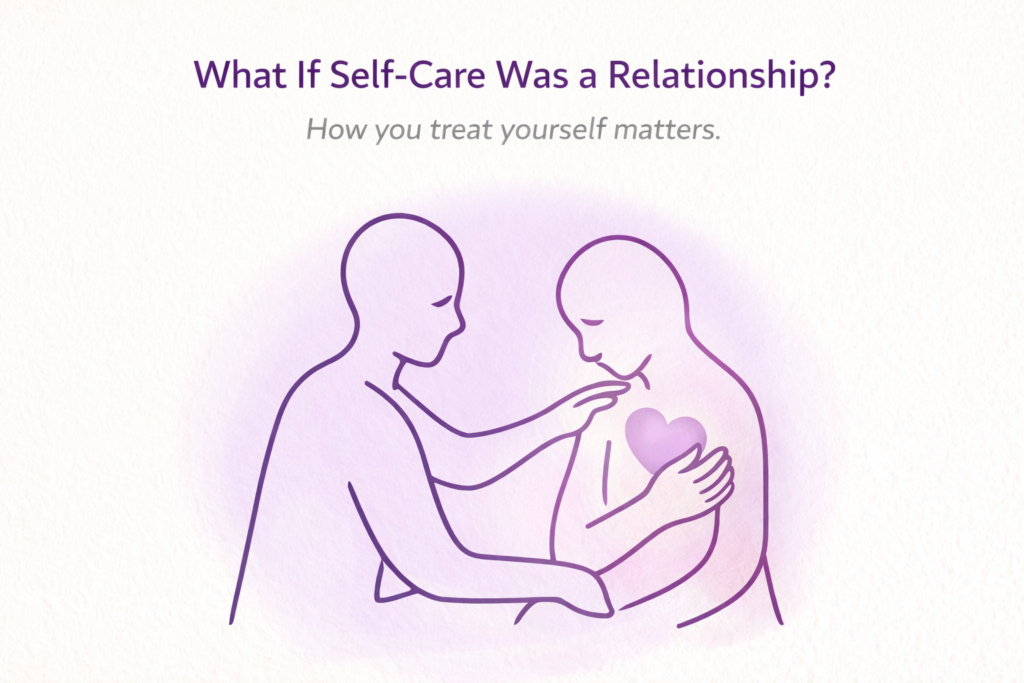
Yourself as Your Best-Friend
When fear appears, imagine the frightened version of yourself standing in front of you.
Now step beside them.
Instead of criticizing, correcting, or trying to make the fear disappear, respond as you would to someone you deeply care about, as your best friend.
I’m here.
I can understand why you’re scared.
What do you need right now?
What do we actually know?
What else might be possible?
We’ll figure out the next step together.
Every time you respond to yourself this way, you’re giving your Protector new evidence: “When something difficult happens, I won’t abandon you.”

Practice the States You Want Available
Our brains become more familiar with what we repeatedly practice. So if we want curiosity, compassion, awe, wonder, creativity, play, and calm to be available when life gets difficult, we need to spend time experiencing them when life isn’t difficult.
This is training.
Notice a sunset. Play without needing to accomplish anything. Get curious about something simply because it interests you.
Play for the sake of playing.
Look for moments that create awe or wonder. Practice compassion when the stakes are low.
Each time we intentionally access these states, we become more familiar with the resources of our Growth Team, making it easier to find our way back to them when our Protector gets loud.
We’re training ourselves to remember that there are ways of experiencing life beyond protecting, achieving, analyzing and anticipating.
Self-Trust Is Built Through Evidence
We don’t think our way into self-trust. We build evidence for it.
Every time I:
- say no when I mean no,
- speak when I would normally stay quiet,
- allow myself to change my mind,
- recover from a mistake,
- ask for help,
- keep a promise to myself,
- pause instead of react,
- or feel fear and move forward anyway…
I give myself another piece of evidence:
I can trust me!
Self-trust doesn’t mean fear stops showing up.
It means we’re becoming more skilled at recognizing it, listening to it, and deciding who gets a seat at the table before we respond.
But there’s another part of this conversation we haven’t explored yet.
Fear doesn’t only come from inside us.
Every day, we’re surrounded by messages competing for our attention.
- Headlines.
- Advertising.
- Algorithms.
- Politics.
- Social media.
- Other people’s fears.
And many of them know exactly how to get our Protector’s attention.
So how do we live in the modern world without handing over the keys to our Survival Team?
That’s where we’re going next with Part 4: Living Beyond Fear
Explore the Fear Series:
- Part 1: What Fear Really Looks Like
- Part 2: Fear As A Gift
- Part 3: From Fear to Self-Trust
- Part 4: Living Beyond Fear