
fear

The Fear Series Part 3: From Fear To Self-Trust

What Self-Trust Actually Means

In Part 1 — What Fear Really Looks Like, we learned to recognize fear and the many masks it can wear. In Part 2 — Fear Is a Gift, we explored why fear exists and met our Survival Team and Growth Team, each offering different resources to help us navigate life.

Now, in Part 3, we move from understanding to practice: learning how to work with fear and build self-trust.


Self-trust is knowing that when something difficult happens, I trust myself to meet it.

It’s trusting that I’ll make the best decision I can with what I know, and if I learn something new, I can adjust.

It’s knowing that when fear appears, I can listen to what it’s trying to tell me and choose how I respond.

It’s recognizing that I have resources available to me, including my Survival Team and my Growth Team, and I can learn to call on the ones I need.

It’s trusting myself to ask for help when I need it, change direction when something isn’t working, and keep moving forward without needing to know exactly how everything will turn out.

Self-trust is knowing that whatever comes, I won’t abandon myself. I’ll meet myself there.

From Reaction to Choice

Understanding our Survival Team and Growth Team is one thing. Learning to recognize which part is leading us in the moment takes practice.

When fear shows up, we don’t need to push it away. We can use it as a signal to pause and bring the rest of our resources into the conversation.

I like to think of it as five simple steps:

Notice → Pause → Listen → Invite → Choose

Notice

Begin by recognizing what is happening.

My Protector is here.

Simply naming it creates awareness. Instead of becoming the fear, we begin to observe it.

Pause

Give yourself a little space between what you’re feeling and what you do next. It might be one breath, ten seconds, a walk around the block, or sleeping on a decision.

The pause doesn’t make the fear disappear. It gives the rest of your team time to join you.

Listen

Get curious about the message underneath the fear.

What is my Protector trying to protect me from?

There may be something important here. Or your Protector may be responding to an old experience that resembles what’s happening now. Either way, we can listen without immediately reacting.

Invite

Now invite the rest of the team into the conversation.

❤️ Heart: What would compassion or connection offer here?

✨ Visionary: What else could be true? What haven’t I considered?

🧠 Thinker: With this broader perspective, what actually needs to be done?

Notice that the Thinker comes back into the conversation. We’re not trying to escape our Survival Team and live permanently in our Growth Team.

We want access to all four.

Choose

Now ask:

What response feels aligned with who I want to be?

This is where reaction becomes choice. We can hear our Protector, use our Thinker, access our Heart and invite our Visionary before deciding what comes next.

And every time we practice this, we’re building evidence that we can trust ourselves.

Self-trust grows when we learn that fear can have a voice without having the final say.

Awe, Wonder and Play Become Practices

Practice the States You Want Available

Our brains become more familiar with what we repeatedly practice. So if we want curiosity, compassion, awe, wonder, creativity, play, and calm to be available when life gets difficult, we need to spend time experiencing them when life isn’t difficult.

This is training.

Notice a sunset. Play without needing to accomplish anything. Get curious about something simply because it interests you.

Play for the sake of playing.

Look for moments that create awe or wonder. Practice compassion when the stakes are low.

Each time we intentionally access these states, we become more familiar with the resources of our Growth Team, making it easier to find our way back to them when our Protector gets loud.

We’re training ourselves to remember that there are ways of experiencing life beyond protecting, achieving, analyzing and anticipating.

Connect with us to schedule your 75-minute Foundations call and start your path to transformation.

The Fear Series Part 2: Fear As A Gift

Where Fear Belongs

In Part 1 of the Fear Series – What Fear Really Looks Like, we explored how fear disguises itself and how our thoughts can keep an emotional reaction alive. But where does fear belong in our daily lives?

A Protector Living in a Different World

The challenge is that our protector was designed for a world that looked very different from the one we live in today.

Thousands of years ago, fear helped us survive immediate physical danger.

A predator, a poisonous snake, an approaching storm, an enemy tribe.

The danger was real, immediate, and usually short-lived.

Today, our protector is often responding to very different kinds of threats in the modern world.

  • A difficult email.
  • Critical feedback.
  • A social media comment.
  • A disagreement.
  • Being left out.
  • Making a mistake.
  • Starting something new.
  • Public speaking.
  • The possibility of rejection.

To our brain and nervous system, these experiences can feel surprisingly similar.

Not because they actually threaten our lives… but because they may threaten something else we’ve learned to protect:

Our belonging.

Our identity.

Our sense of worth.

This is where Dr. Jill Bolte Taylor’s model of the four parts of the brain becomes incredibly helpful…

Dr. Jill Bolte Taylor’s Whole Brain Living framework offers a simple way to understand what may be happening inside us when fear shows up.

She describes the brain as having four main “characters”:

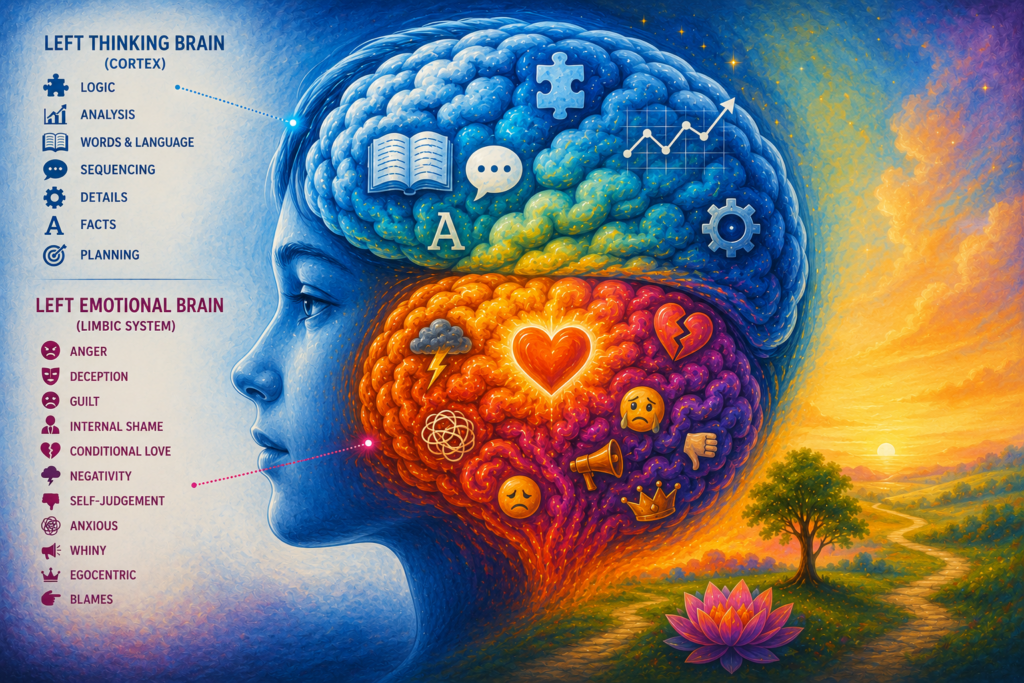
  • the left thinking brain – logic, planning, words & language,
  • the left emotional brain – fear, anger, self-judgement, anxious,
  • the right emotional brain – compassion, playful, curious,
  • the right thinking brain – calm, helpful, generous.

From now on we’ll refer to them as your Survival Team and your Growth Team.

Survival Team

  • 🛡️ Protector (Left Emotional)
  • 🧠 Thinker (Left Thinking)

Growth Team

  • ❤️ Heart (Right Emotional)
  • ✨ Visionary (Right Thinking)

In this model, fear is often connected to the left emotional brain, the Protector, which she describes as the part of us wired for fight, flight, or freeze.

This part is not trying to ruin our lives. It is trying to protect us, often by comparing what is happening now to something we have experienced before.

This is why fear can feel so convincing. The present moment may only hold a comment, a facial expression, a decision, a deadline, or a small uncertainty — but the Protector may connect it to an old story of rejection, failure, shame, danger, abandonment, or not being good enough.

Meet Your Survival Team

🛡️ The Protector

The Protector is not bad. Its fear, anxiety, anger and other powerful emotions aren’t our enemies. They carry information and help us recognize, learn from and respond to our experiences. But when fear is activated, it can narrow our view and make something happening now feel connected to something that happened before.

Every second of every day, this part of the brain, along with the body, is asking one important question:

“Am I safe?”

It’s comparing what is happening right now with everything you’ve experienced before.

  • Have I felt this before?
  • Did this end badly?
  • Should I be careful?
  • Do I need to protect us?

It does all of this in less than fraction of a second, often before we’re even aware it’s happening.

Isn’t that incredible?

Without this part of our brain, our ancestors wouldn’t have survived.

They needed a system that could instantly recognize danger and prepare the body to respond.

Fear isn’t a mistake.

Fear is a gift.

When the Protector sounds the alarm, it has a very capable teammate ready to help.

🧠 The Thinker

The Thinker analyzes, organizes, plans, remembers details and solves problems. When the Protector says, “Something might be wrong,” the Thinker naturally wants to figure out why and what to do about it.

The Protector sounds the alarm. The Thinker tries to solve the problem.

We’ve become exceptionally good at using this part of ourselves. Much of Western culture rewards analyzing, planning, productivity, achievement and getting the right answer.

These are valuable resources.

But they’re not the only resources available to us.

That’s only part of the story.

Coming Next: From Fear to Self-Trust

Understanding why fear exists changes our relationship with it.

We don’t need to get rid of our Protector. We don’t need to stop thinking. And we certainly don’t need to become fearless.

We need to learn how to recognize who’s leading the conversation—and remember that we have an entire team of resources available to us.

But understanding something and living it are two very different things.

So how do we actually do that?

How do we catch ourselves when fear takes over?

How do we pause long enough to invite compassion, curiosity, perspective and possibility back into the conversation?

And perhaps most importantly, how do we learn to trust ourselves when we don’t know what’s going to happen next?

That’s where we’re going next.

Part 3: From Fear to Self-Trust
Learning to trust not that everything will go according to plan, but that we have what we need within us to meet what comes.

Connect with us to schedule your 75-minute Foundations call and start your path to transformation.

The Fear Series Part 1: What Fear Really Looks Like

Fear does not always look like fear

This is one of the reasons fear can be so difficult to recognize in ourselves. We may not walk around thinking, “I am afraid.” Instead, we think, “I need to get this right,” “I can’t deal with this right now,” “They’re going to be upset with me,” “I should have known better,” or “I just need to stay in control.”

Sometimes it looks like anxiety.
Sometimes it looks like anger.
Sometimes it looks like control.
Sometimes it looks like procrastination, perfectionism, people-pleasing, silence, over-explaining, or the deep need to disappear.

Fear often arrives wearing a mask.

Why the Feeling Lasts Longer Than the Emotion

One of the most helpful ideas I’ve come across comes from Dr. Jill Bolte Taylor, neuroscientist and author of Whole Brain Living. In the book, she explained what she calls the 90-second rule.

When an emotion is triggered, there is a chemical response that moves through the brain and body. If we don’t continue feeding that emotion with our thoughts, that first emotional wave naturally moves through us in about 90 seconds.

That idea stopped me in my tracks.

Because if that’s true, then what kept me awake all night wasn’t the original emotion.

It was the story I kept telling myself.

This does not mean emotions are not real. They are very real.

Fear is information.

Anxiety is information.

Anger is information.

Sadness is information.

The question becomes:

Are we responding to what is happening right now… or are we reacting to a story the past has reactivated?

Fear Has Many Faces

Before you keep reading, I’d like to ask you something.

Have you ever considered that what you’ve been calling stress, perfectionism, procrastination, people-pleasing, feeling small, anger, or overthinking might actually be fear?

The mind can become incredibly good at disguising fear. It can take so many forms that we often miss it, judging the behaviour instead of recognizing the protection underneath it.

Fear doesn’t live only in our thoughts.

It can speak through our thoughts, our bodies, our emotions, our relationships, and our behaviours.

The more we learn its language, the easier it becomes to recognize.

Here are some of the ways fear can appear in everyday life:

Fear in Your Thoughts

Sometimes fear sounds like a conversation happening inside your own mind.

☐ Overthinking
☐ Racing thoughts
☐ Worst-case thinking
☐ Self-doubt
☐ Imposter syndrome
☐ Needing certainty
☐ Comparing yourself to others
☐ Intellectualizing
☐ Judgment of yourself
☐ Seeking approval
☐ Trying to prove yourself
☐ Feeling small
☐ Feeling trapped
☐ Feeling unsafe
☐ Feeling exposed
☐ Feeling like you must disappear


Fear in Your Body

Sometimes your body notices fear before your mind does.

☐ Tight chest
☐ Shallow breathing
☐ Stomach discomfort
☐ Nausea
☐ Lump in the throat
☐ Jaw clenching
☐ Headaches
☐ Fatigue
☐ Trouble sleeping
☐ Restlessness
☐ Panic
☐ Hypervigilance
☐ Emotional numbness


Fear in Your Emotions

Fear doesn’t always feel like fear.

It can look like…

☐ Anxiety
☐ Anger
☐ Irritability
☐ Shame
☐ Guilt
☐ Embarrassment
☐ Sadness
☐ Dread


Fear in Your Relationships

Fear often influences how we connect with other people.

☐ People-pleasing
☐ Reassurance-seeking
☐ Over-explaining
☐ Apologizing too much
☐ Withdrawing
☐ Isolating
☐ Clinging
☐ Jealousy
☐ Mistrust
☐ Conflict avoidance
☐ Criticism
☐ Sarcasm
☐ Judging others
☐ Trying to keep everyone happy
☐ Feeling responsible for everyone
☐ Rescuing others
☐ Avoiding intimacy


Fear at Work (and in Life)

Sometimes fear shapes the opportunities we do—or don’t—take.

☐ Procrastination
☐ Perfectionism
☐ Avoidance
☐ Not starting
☐ Not finishing
☐ Delaying decisions
☐ Quitting before being judged
☐ Avoiding visibility
☐ Not speaking up
☐ Undercharging
☐ Avoiding success
☐ Avoiding failure
☐ Avoiding change
☐ Avoiding commitment


Fear as Protection

Some of fear’s masks are surprisingly clever.

They don’t always look like fear.

☐ Control
☐ Micromanaging
☐ Defensiveness
☐ Shutting down
☐ Freezing
☐ Numbing out
☐ Staying busy
☐ Busyness as avoidance
☐ Checking and rechecking
☐ Grandiosity as protection
☐ Saying, “I don’t care,” when you actually do

Looking at this list, it’s easy to realise that fear isn’t just one emotion.

It’s often the hidden driver behind many of the behaviours we struggle with.

Before we can change the hold fear can have on us, we have to recognize it.

Connect with us to schedule your 75-minute Foundations call and start your path to transformation.